Showing posts with label Brecks. Show all posts

Thursday, 7 July 2016

Weeting Warden's Diary: June

By Sophie Harrison and Abi Nell

The end of May was wet and cold, but despite this a new pair of stone curlews arrived and started sitting on eggs at NWT Weeting Heath. After sifting through our records we discovered that the male bird with ring combination (BTO, ORG, RED, RED) was originally ringed back in 2012 not far from Weeting. He had been previously recorded at Weeting in both 2013 and 2014 with a first nesting attempt recorded on neighbouring land in 2015. His partner with ring combination (LBU, -, LGN, DG/BTO) was first ringed in 2012 on Hockwold heath and had her first breeding attempt with another male in 2014. Stone curlews mate for life and only change partners if one passes away. This male is therefore her second partner and more her own age.
 

A heat wave at the beginning of June gave this pair a fighting chance and they were spotted taking turns to incubate the eggs a few days later. We were able to capture this pair on camera on 6 June and hopes were raised that this pair could rescue this year's breeding population at Weeting. However, a few days before hatching these hoped were dashed! Late one night, a hungry passing opportunist in the form of a vixen took quiet a fancy to these eggs… and had herself a tasty midnight snack! She was first seen at 23:19pm when she carried off the first egg. The crafty vixen then returned to gobble the second egg a minute later. The birds were then seen at 23:25pm when they returned to their empty nest. Dismayed, they abandoned the scrape. Their dismay was also shared by the team here at Weeting!

Since this happening on 12 June, this pair has been feeling sorry for themselves and have been seen moping about the heath looking a bit lost! We have been watching this pair very closely to see if they will have one last breeding attempt before the end of the season. However, as June begins to draw to a close, this look less likely as the stonies will require three weeks for egg incubation and six weeks for the chicks to fledge.  Earlier this week the pair were seen displaying and giving each other food parcels. Maybe this is in consolidation over their loss or it may be a positive sign signalling another breeding attempt! Fingers crossed that July's blog will have some hopeful news!

On Saturday 4 June, Weeting Heath held the event ‘Fantastic Night Fall Flyers’. The aim of the evening was to see if we could find bats, moths and nightjars unique to Weeting Heath. The event was a huge success with a great turnout! Many thanks to Matthew Blissett for his fantastic tepee moth trap set up! This trap along with four others running that night produced some fantastic moths!  Highlights included the Breckland specialist Lunar Yellow Underwing, and also fox moth, clouded buff, and elephant hawk moth (heathland specialists).

However it was the Cream Spot Tiger with its striking distinct colouration that stole the show! Cream Spot Tigers  feed on dandelion, dock and plantain. When threatened, they flash their bright red abdomen and yellow and orange underwing to avoid being eaten! (Rumour on the bird grape vine also informs me that they don’t taste very nice either!!) It may be one of the UK’s most beautiful and distinguishable moths with its striking pale spots, but this defence is necessary when they have one of the UK’s smallest population distributions!
We were out in force with bat detectors that evening,  and  picked up Soprano and common pipistrelle. Even the stone curlews were playing ball that night, as right on cue a pair soared over the pine belt during the late night walk in full view calling loudly to each other! The evening was rounded up with hot chocolates (complete with marsh mellows and cream of course!) and home baked cookies from Weeting’s star baker- Abi Nell.

The weather hasn’t made its mind up this month so has greatly confused many of our breeding species here at Weeting. Consequently, spotted flycatchers have not yet been able to breed successfully in the pines and butterfly counts have been low and in-frequent. However, when the sun decided to shine we had Holly Blues emerge and the first generation of Meadow Browns for the season! The only species that has been unaffected by this weather is the treecreepers! Terry and Teresa that decided to nest behind the VC sign last year decided they wanted a change of scenery. They relocated behind a drainpipe on the side of the west hide. This move was clearly a well thought out idea as they successfully fledged all four chicks!

This month was also the relaunch of the Breckland Local Group. The first meeting was a huge success with guest speakers Matthew Blissett and Sam Neal talking about the fantastic wildlife and reserves in the Brecks, and how important it is to get involved with monitoring and conservation work. The next event is a guided walk at Weeting Heath at 10am on Sunday 10 July. Come and discover the great variety of flora and fauna that Weeting Heath has to offer! Entry is £2 for members and £3.75 for non-members. Pop into Weeting Heath Visitor Centre for more information or contact the Breckland Local Group on 01953 548304 for more information.

An easy way to get involved with wildlife monitoring or recording in the Brecks  is to find out what NBIS (Norfolk and Norwich Naturalist Society) has to offer. Sophie and Abi have been taking advantage of the fantastic free courses from NBIS as part of their Little Ouse Wildlife Recording Festival this month. One Tuesday night they attended a freshwater invertebrates identification session with Dan Hoare (Norfolk and Norwich Naturalist Society) and the NBIS team at St Helens picnic site. The sections of the Little Ouse we sampled were full of life, with many keystone species and species that indicate river health. We discovered larvae a plently including this rather smiley beetle larvae and were amazed by the number of tiny stickle-backs, minnows and bullheads that found their way into the net! Follow the link to find out more about the NBIS events programme.


Now live: watch Sophie show YouTuber, Maddie Moate our stone curlews in NWT's 9 for 90 film in celebration of our 90th anniversary.


Monday, 8 February 2016

The Ovington Ramblers: Thompson Common


Maureen Simmons

Pingo at Thompson Common
Walking around Thompson Common is like a magical mystery tour.

Starting at the car park on the A1075, just South of Watton, we first walked through the wooded area. Here there are many ponds filled with crystal clear water from the chalk springs below; branches from old trees hanging across the ponds creating an ancient, eerie atmosphere. New bright green shoots of the water plants were plain to see – a sharp contrast to the graceful remains of last season's bullrushes. These fascinating ponds are known as “pingos” and they were created at the end of the last Ice Age, 12,000 years ago and today they provide a unique habitat for nearly 60 threatened species. 

Blue sky reflecting on fresh water mint

 
The pleasant walk continued on a quiet country lane, abundant with snowdrops, and then on to open fields. Here there was a large herd of sheep peacefully grazing in the late winter sunshine, playing their part in protecting this special site. We noticed they had chewed off the bark of a group of young birch trees. Were they taking advantage of the sweet birch sap rising at this time of year?

As the sun was beginning to sink down, we didn't reach the final part of the walk to Thompson Water. We decided to go there another day to (hopefully) spot an otter or two!

Meet Angela Wynne, who takes the majority of the photos for our posts.

The Ovington Ramblers are a small group of friends who have decided in their 20th year of walking together that we will try to visit all the Norfolk Wildlife Trust reserves in their 90th Anniversary year.

Monday, 4 May 2015

Operation Sock Cam!


Sophie Harrison, Summer Warden

Over the last few weeks the stone curlews have started to settle on the heathland. There are now three established pairs all on scrapes. Pairs 1,2, and 3. But it is pair 3 that is to be the star of the Brecks! Our enthusiastic visitors have become quite fond of this pair, naming them Cynthia and Hue.

This year NWT Weeting Heath is part of one of the exciting Breaking New Ground projects called ‘Wings over the Brecks’. This project has been formed between the RSPB, The Forestry Commission and Norfolk Wildlife Trust. Weeting Heath is the first site to have a camera up and running recording live footage of our secretive stone curlews!

Before the arrival of the stone curlews, 150m of camera cable was set up on the heathland. Many different designs were explored by the team to find the best possible disguise for our camera...

In the end, our Reserves manager sacrificed one of his socks to expertly camouflage the camera… and Sock Cam was born! 


The launch of Sock Cam onto the heath was scheduled for a hot and sunny day. This is vitally important, as it minimises the risk of the eggs getting cold when the adults temporarily leave the nest. With radio communication between the team, we found the scrape and set Sock Cam into the ground at a suitable distance. To our delight, Cynthia and Hue returned to the scrape only 20 minutes after Sock Cam was in place.

Sock Cam went live on Friday 24 April and has already captured some interesting behaviour.

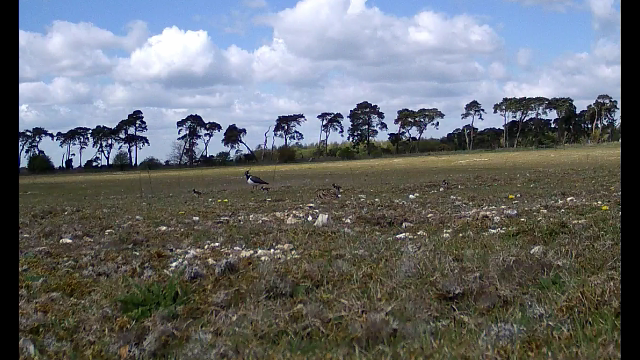
Last Friday, it captured a stoat being bombarded by lapwings. Just as it thought it had escaped, it ran into a pair of rabbits! The lapwing and rabbits joined forces to form a two pronged attack against the stoat. After a lot of scraping and the stoat leaping in the air, it hot footed it back across Sock Cam with both lapwing and rabbits in hot pursuit. While this was all going on, all the stone curlews managed to do was turn their heads and watch the drama unfold!

Other footage captured has included nest changeovers. Both Cynthia and Hue take turns sitting on the eggs, and generally swap over every two hours. The timescale of one bird arriving to the initial swap over is usually 30 seconds to a minute. However, one wet and windy day Cynthia was very reluctant to leave the nest so made Hue stand in the wind and rain for an extra two minutes. In retaliation, he then shoved her off the nest to sit down.

Both stone curlews and lapwings nest on the heathland, often in close proximity. They may join forces to see off a predator, but do not get along well with each other: stone curlews will quite happily kill and eat a lapwing chick.

During my morning’s observations I saw an unpaired male stone curlew get a little too close to a lapwing chick. Naturally the lapwing parent went ballistic: bombing, pecking and flying at the stone curlew. Reluctantly, with wings and beak outstretched, the stone curlew gave up and the lapwing chick escaped!

One of my favourite bits of footage from Sock Cam is a drake lapwing leading his four chicks across the heath. They come right behind the scrape and Hue doesn’t even bat an eyelid, as he was more intent on sitting on his eggs.

The stone curlew eggs are soon to hatch, so watch this space for future Sock Cam updates!

Monday, 27 October 2014

End of the season at Weeting Heath

Matt Twydell, Weeting Heath Summer Warden
 
It is now the end of the season here at NWT Weeting Heath and unfortunately the end of my summer contract here, I have enjoyed my time here at Weeting Heath and the season has flown by. The dropping temperatures and leaves are the starting signs of autumn and winter, other signs on the reserve are the appearance of several fungi that have been sprouting up at Weeting. 

This year has been a good year for the main attraction at Weeting Heath, the stone curlew. Five pairs nested on Weeting Heath this year producing five chicks that fledged from in front of the hides which is the highest for several years.

Three of the fledged chicks came from one pair which managed to have two broods this year. This pair consists of an unringed female and a ringed male which we call Upper Right Black, due to the ring combination including a black ring on its upper right leg (original name I know!). The ringing of stone curlews is part of the Stone Curlew Recovery Project and has been going since the 80s, it gives us an insight and important data into where the stone curlews breed, potential survival rates and where they overwinter from year to year.


What makes Upper Right Black interesting is that we have been told potentially this bird was first ringed as a chick in 1990! Making this bird the oldest recorded bird in the project at an age of 23! This bird was part of a pair which successfully reared and fledged three chicks this year. Below is a video I took on my phone earlier in the season showing Upper Right Black with two of its chicks and on the right a close up picture of one of his chicks we ringed this year, lets hope his chick will make it to 23 as well and be back at Weeting Heath in 2037!


Stone curlews normally depart at the end of September or start of October to overwinter in southern Spain or northern Africa such as Morocco (something I know I would like to do). There has been one or two records of stone curlews overwintering in this country when whether conditions are mild enough. So potentially if Upper Right Black has been flying to southern Spain for the last 23 years, it means he has flown roughly a staggering 55,000 miles in its life time, which is twice the circumference of the Earth at the equator!

Other interesting wildlife seen this year include two cranes flying over the reserve in June, which means that 95 species of bird were recorded at Weeting Heath this year. A clouded yellow butterfly was also recorded on the reserve which brought the total number of species for this year to 24. Bats were also recorded for the first time this year at Weeting Heath through the free Norfolk Bat Survey, which anyone can take part in. The results showed that at least eight species of bat use the reserve including brown long-eared, noctule and 

Daubenton's.


Spiked speedwell flowered early this year at the end of June rather than July and August due to the warm weather, with over 550 flowering plants counted.

So the season has now ended and the reserve is now all shut until next March, hopefully you will come visit next year where you might get to see old Upper Right Black celebrating his 24th year.

Cheers

Saturday, 26 July 2014

Flora on NWT Weeting Heath


Matt Twydell, Weeting Heath Summer Warden
 

Spiked speedwell
NWT Weeting Heath is a prime example of a Breck Grass Heathland. Because of this we get a number of specialist Breckland plants that grow here. The main and rarest one is the Spiked Speedwell Veronica spicata (Eastern sup species). This plant flowers on the heath during July, some of the denser patches are fenced off at Weeting to protect the plants from grazing.
 

Spanish catchfly

A lot of the plants that grow at Weeting require ground disturbance for the successful establishment of new seedlings, this can be accomplished through turf stripping, rotivating or naturally through livestock or rabbits. One plant that benefits from disturbed ground is Spanish Catchfly Silene otites, these inconsequential flowers make this a hard to spot species in the long grass. 


One of the more vibrant flowers that grows here is the Maiden Pink Dianthus deltoides, which seems to have been spreading in recent years.


Maiden pink

Broad Leaved Hellborines, one of the few Orchids recorded at Weeting Heath are now in flower outside the Visitor Centre in small numbers.

Most of these plants grow in areas which are restricted to the public due to nesting stone curlews or woodlarks. You are only able to venture onto the heath when being accompanied by either the warden or a volunteer, but please do enquire at the visitor centre.


Stone Curlews
Over the last month we have had an increase in stone curlews at Weeting Heath, with a peak count of 17! Most of them are part of a post breeding flock which includes juvenile and adults. But we do have a couple of new pairs that have arrived. One of these went down on a nest a couple of weeks ago, so fingers crossed we shall have some more chicks by the end of the first week of August.

We also rang another chick several weeks ago, which has this type of flag on its leg, so keep an eye out for it.
Stone curlew chick


The upper right black (its ring combination) pair, who have fledged 1 chick already, hatched another 2 chicks last week as well. We will be hoping to go out and ring these as well in a few weeks.


Skipper on scabious plant
Other Wildlife News
Last week I found a juvenile redstart in the pines on the heath, which probably means that they bred on site or the surrounding woods, which is a first for a number of years here at Weeting.


Turtle doves, now a rare site in the countryside, continue to be seen on the woodland trail here at Weeting, with a total of three singing males being seen, young haven’t been seen so far but hopefully they have successfully fledged young this year.

Butterflies continue to be seen in good numbers. On my last butterfly transect I counted over 300 individual butterflies comprising 15 different species; the first painted lady of the year was also seen on the site last week.

Friday, 20 June 2014

If you like stone curlews then you should put a ring on it...

Matt Twydell, Weeting Heath Summer Warden

So like the line from that song (I really shouldn’t admit to knowing it!) we decided to ring the chick outside the hide last week. Fortunately the weather was favourable, as the chick - as you can see from the photo - is quite big now. This chick is one of the two from the video I took on the last blog. The chicks are rung in conjunction with the RSPB, for monitoring purposes.

The plan was  simple, several of us were to position ourselves in the hides directing Tim from the RSPB as to where the chick was. Usually stone curlew chicks, like other ground nesting birds, will “hit the ground” and keep completely still, relying on camouflage to hide from predators.

This one, however, decided to be a “runner”, and as soon as Tim got close, it went off like the road runner (meep meep), and this made for quite comical few minutes watching Tim chase the bird from the hide!

It  was back in May that we found the scrape and the mottled camouflaged eggs.


It was quite amazing to get up close to a stone curlew, from my normal view point through a scope. Seeing their huge eyes up close, was particularity interesting.

 The whole process of recording weight - which was 336g for this chick - and other data as well as fixing the rings only takes around 10 minutes. So disturbance to the bird is minimal, and the parents who watch from a distance returned within 10 minutes of us leaving the chick in the undergrowth.

So keep your eyes out for this chick and this ring combination from the hides!

This chick has now fledged and been kicked out by its parents. This pair will hopefully decide to re-lay over the next week, and fingers crossed we shall have another set of chicks in July.

The pair of stone curlews who lost both of their chicks early on in May, have successfully brooded two more, and they have been viewable from the West hide the past few days.

Stone curlews have a varied diet of invertebrates. I have witnessed them eating big worms and running around trying to snap butterflies from the air. But the other day I saw a peculiar sight, when one parent tried to eat and then feed a chick a young mole, needless to say the chick had trouble finishing its meal!


Other Wildlife news at Weeting Heath


A pair of spotted flycatchers have nested in one of the pine trees not far from the Visitor Centre. They have been more active snapping moths and flies out of the air this last week so probably have hungry chicks to feed.

We also had  two common cranes fly over the centre last week, which was quite exciting as these are the first I have seen in this country, heading in the direction of Lakenheath.

Living on site, I often see bats at night flying around the visitor centre. I was curious as to what species we had here. So I decided to take part in the Norfolk Bat Survey. Anyone can take part, you can find more details on http://www.batsurvey.org/.

I picked up the equipment and set it up over three days, the memory card was then sent to be analysed. The results showed that I recorded an amazing 10 species of bat at Weeting Heath, these were common pipistrelle, soprano pipistrelle, noctule, barbastelle, brown long-eared, Daubentons, serotine, leislers, and low confidence of whiskered and nathusius pipistrelle.

The bats will be mostly feeding on moths, here at Weeting Heath over 300 species of moth have been recorded, including these from the latest moth trap.

It’s amazing what species are around us that we don’t know about.

Butterflies and damselflies have also been abundant in the last few weeks, with 15 species being recorded including the first meadow browns, large skippers and ringlets being seen.


Saturday, 17 May 2014

The Brecks: curlews and pingos

Isabelle Mudge, Seasonal Education Officer
 
The Education team has recently been on a visit to the Brecks to learn about the sensitive and rare habitats in the area, and about those species which thrive on them.

Stone curlew, photo by Jessica Riederer
The heathland at NWT Weeting Heath is very different from that at NWT Roydon Common, where a sea of purple in late summer is clear evidence of the heather. Lacking heather, Weeting Heath is perhaps less impressive, but this is only at first glance - if you look more closely at the ground you see an incredible patchwork of different colours and textures thanks to the great variety of mosses and lichens which cover the surface of the soil. It is these, and the numerous other plants exclusive to heathland habitats, which amaze the botanists who come here. It is also this environment that attracts birders from near and far to see lapwing, nightjar and stone curlew. Having heard so much about the elusive and rare stone curlew, we were all thrilled when, after scanning the area for some time, we were lucky enough to see first two, then four stone curlews! 

Pingo at NWT Thompson Common
Following our visit to Weeting, we went on to see the pingos, which are ancient glacial formations, at nearby NWT Thompson Common. The pingo trail gives the impression of going back in time, by initially taking you through what looks a bit like a prehistoric jungle swamp where the several pools of water are often concealed by dense vegetation. Then out in the open, however, the clear water of the pingos is exposed and brimming with life, with an abundance of freshwater invertebrates, and several plants such as water violets and lilies, making the pools beautiful and unearthly.

We had a fantastic day, and came away feeling that these two contrasting sites provide the visitor with a unique experience not to be missed.

June's Wildlife Watch event for children takes place at NWT Weeting Heath. Come and discover our Magical Moths!