Chris Durdin, NWT Volunteer
Pretty damsels
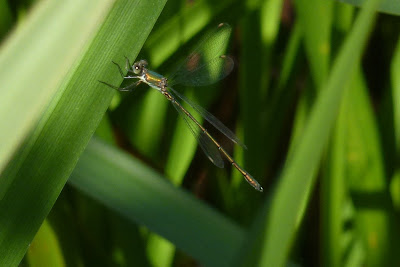 |
| Willow Emerald Damselfly (Chris
Durdin) |
Lurking with binoculars to get good views of pretty damsels
seems, at first hearing, a little suspicious. But the explanation at Thorpe Marshes is innocent enough: the object of my attention is the Willow Emerald
Damselfly.
It’s also known as the Western Willow Spreadwing and the
first photo shows where the spreadwing name comes from. The second photo, below, shows
how the urge to mate can lead to confusion: it’s a male Common Emerald grasping
a female Willow Emerald.
 |
| Common Emerald male and Willow Emerald female (Derek Longe) |
The distribution map for Willow Emerald in the Atlas of
Dragonflies in Britain and Ireland, published in 2014, shows lots of spots in
coastal Suffolk and Essex and just the odd one in east Norfolk. But that’s
already well out of date: they are in much of Broadland and records are
increasing in west Norfolk,
the Fens and as far west as Northamptonshire.
That was the gist of the story I explained to last week’s
group on the monthly walk at Thorpe Marshes, perfectly timed, I hoped, for this
late season damselfly. We know the best spots to see them, on perches over open
ditches. Some surface vegetation, such as frogbit, is fine, but once ditches
get clogged up with lesser water parsnip and other vegetation the damsels move.
However the best time to see a Willow Emerald here is during
the afternoon on a still, sunny day. This morning it was partly cloudy and
breezy and the star of the show I had talked up was out of sight.
 |
| Orange balsam (Chris Durdin) |
Still, the supporting cast was strong. There were blue-eyed
Migrant Hawkers, Ruddy and Common Darter dragonflies; various butterflies and other
insects were enjoyed along with a host of late summer flowers such as hemp
agrimony, water mint and orange balsam. This last species is less dominant than
Himalayan balsam, which happily is not established here.
We’d done the circuit round the marshes and, around noon, returned to a favoured spot
near the start of the walk. The sun was out now and there it was: a male Willow
Emerald on territory, and helpfully still enough to get my telescope onto it.
The walks always seem to have a mix of regulars and new attendees and it was especially
nice to hear the appreciation of the new people of this fine view. Comments
showed that they could see why I am little bit in love with this pretty damsel.
There are certainly 20 Willow Emeralds at Thorpe Marsh this
year and probably quite a lot more. After the group had gone, two of us watched
one from the railway bridge where you enter the reserve. This one was jostling
with a Common Darter for a favoured perch. The Willow Emeralds tend to move if
a bigger hawker comes close as they may be prey, but it was striking how
similar in size this large damselfly was to the small darter. The dragonfly was
twice displaced by the slim damselfly, but the bulkier darter won the tussle in
the end.
20/20 visions
The Willow Emerald is the twentieth species of odonata –
dragonflies and damselflies – at Thorpe Marshes this year. This is two more
than our regular 18 species. The new ones are Small Red-eyed Damselfly and Broad-bodied
Chaser, though neither was confirmed as breeding. The NWT’s management last
winter restored ponds and created patches of open ditch. The latter is where both
new species showed; there were several sightings of Broad-bodied Chaser in June
and July, often perching on the same twig.
Twenty is an impressive total for our fairly small – 25
hectare – nature reserve. Ever since Pam Taylor,
Norfolk’s
dragonfly guru, suggested to me that 20 species makes a ‘good site’ the pressure
has been on to reach that total. And now we have.


