Showing posts with label woods. Show all posts

Wednesday, 30 November 2016

NWT Breckland Local Group: A butterfly ramble at East Wretham Heath Reserve


As winter draws in with cold frosty mornings - Carole Herries, Secretary of the NWT Breckland Local Group reflects back on a lovely day out earlier in the year in Breckland where she and the group encountered a host of butterflies and a beautiful moth.
  
'On a fine autumn morning on 14 September 2016, 21 members of the NWT Breckland Local Group set out on a walk at East Wretham Heath Reserve. The walk started at the information board on the reserve, and was led by the Matt Blissett, the Breckland Reserves Manager.
Peacock moth with 'footprints'


On the walk, the group viewed the many Breckland pine trees that are a key feature in the landscape.   Another welcome sight was a beautiful peacock moth with its characteristic footprint-like markings on its wings quite evident. 
Small copper butterfly


Later on a small copper provided a colourful display for us.  During our visit we walked through the wooded area of the reserve, the route taking us on a 3 mile walk which took approximately 2 hours. 


Speckled wood butterfly

Amongst some of the ferns, we observed a speckled wood butterfly which posed very nicely for the camera. Matt's talk was very informative and enjoyable talk whilst walking around the reserve - refreshments and a chat afterwards completed a really good morning.


The Breckland Local Group have recently reformed and are hoping to organise several more walks next year.'
www.norfolkwildlifetrust.org.uk/support-us/local-groups/breckland-local-group
 

All photographs by Carole Herries 

Monday, 28 November 2016

The Ovington Ramblers: Swangey Fen

The Ovington Ramblers recently visited the penultimate site in their 90th anniversary tour of  NWT reserves- this was an extra special visit to Swangey Fen. This is a reserve which can be visited but only as part of a prearranged and guided group tour on request so a special day out for everyone.

This week we were privileged to be shown around Swangey Fen, an ancient wet woodland of almost 50 acres near Attleborough.  Our guides were Richard and Hillary, two enthusiastic, hard-working volunteers with an obvious love of the site they have been caring for for the last 20 years. 
Black rush and saw sedge, Swangey Fen


We were given a brief history of the area as Richard told us that a hundred years ago this was an area where the local poor people could come and forage for food and fuel.  It was later taken over by the Otter Trust where a successful breeding programme resulted in the many otters in the area today.  Finally, when the Otter Trust's work was over, they donated the site to Norfolk Wildlife Trust in 2009.

Richard and Hillary visit the fen 3 or 4 times a week during the summer and about once a week in winter, cutting the reeds on a 2 year cycle, clearing pathways, making and repairing bridges and walkways, servicing dykes and checking water levels and so much more. Sometimes volunteer groups give a helping hand with the larger tasks, but Richard and Hillary are always there for the everyday tasks and we take our hats off to them!


At present they are actively helping the growth of the black bog rush, collecting and storing the seeds in an airing cupboard at home.  They are also protecting areas of saw sedge and encouraging the development of this plant which is used by thatchers on the ridge of thatched roofs.
Mound of reeds Swangey Fen
Walking between the birch, alder, ash and sallow you come across huge mounds of reeds and rushes collected from many years' cuttings, which now provide homes for small mammals and snakes. Here and there you can spot a beech tree in its autumn glory shining through the branches of the other leafless trees. 

Wax Caps


At this time of year the fen is very wet and boggy (as two of us found out when we ended up on our bottoms).  You can clearly see lots of different size hoof prints from the numerous red, roe and muntjac deers that frequent the fen.  We also saw where the deer had chewed off all the bark of a fallen sallow to obtain the salacylic acid.  Salacylic acid forms the basis of the common aspirin, so we can only assume there were plenty of deer with headaches that day!


*********************************************************************************

Help us protect Hickling Broad – the heart of the Norfolk Broads

Please donate today:

  •  Call: 01603 625540
  • Text LAND26 TO 70070 with the amount of your donation (£)*

    *(Please  note that you may incur a standard network message charge based on your service provider rates).  

Monday, 26 September 2016

The Ovington Ramblers: Brett's Wood and Thursford Wood


Today we visited two very different woods close to each other off the A148 Fakenham to Holt Road. Both have small off road parking places.


Beefstead fungus in Thursford Wood
First we went to Brett's Wood, the larger of the two and one of NWT newest reserves. A former conifer plantation, the area is being restored to woodland. It is a very peaceful place and the pathways are wide and easy to walk. You can see areas that have been opened up to enable light to the woodland floor, which is encouraging new growth of plants and saplings. A large and exciting work in progress.

In complete contrast and just along the road is Thursford Wood, one of the last remaining ancient wood pastures in Norfolk. Hundreds of years ago the pasture was grazed by cattle with a few trees that were pollarded at two metres from the ground, so the new growth couldn't be reached by the animals. You can easily spot the ancient oaks and still see where they were pollarded, although this practice ceased around 1800.  Some of these trees are thought to be 500 years old!
 
Ancient oak


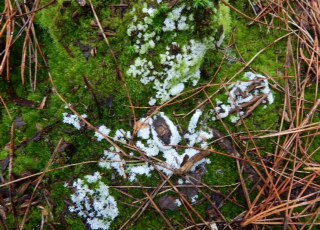
Lichen like tiny flakes of snow
Autumn is my favourite time of year and at the moment Thursford Wood is a feast for the senses.  Woods have their own distinctive smell and during autumn it is more pungent as you feel the damp rich loam beneath your feet. The sight of the ancient oaks, gnarled and magnificent, spark the imagination of times long gone and seeing many fungi in all shapes and colours was an added bonus. The sound of birds singing, no longer to attract a mate, but – it seemed – just for the joy of it, altogether made this a magical and memorable walk for us all.

Monday, 20 June 2016

The Ovington Ramblers: Honeypot Wood


Joyce Woods


Our walk today took us to Honeypot Wood, an ancient woodland, approximately 4 miles from Dereham. During World War II it was used as a bomb dump area as a result of which it had still visible concrete roads around and across the site. This made access easier than would otherwise have been after a day of heavy rain.


Throughout our walk we looked carefully for twayblade, greater butterfly orchid and broad leaved helleborine ,the three flowers mentioned in the handbook, but sadly we were unable to see any of the three. However we did see lots of speedwell, vetch, wood avens, both pink and white campion, bugle and, best of all, herb paris (never seen that before so proved to be an exciting find).


The saddest part of the day was seeing ash tree dieback throughout the wood. It seemed to involve trees of all sizes from very large to those which had cut down and had started to regrow not always with success. We noted many cut and tied bundles of long straight branches of small diameter and wondered if they were destined for garden spade/fork handles.


We heard many birds competing for top birdsong prize but felt it must go to a robin at the top of a dying ash tree. We saw rabbits but no deer although evidence was visible in the form of fern tip and wild rose pruning.


It was an interesting walk but we felt great sadness over the plight of the ash trees there.

Wednesday, 11 May 2016

The Ovington Ramblers: Wayland Wood

Maureen Simmons


Our walk this week took us just a short distance away to Wayland Wood- always a lovely site to visit but particularly at this time of the year. We chose a lovely sunny morning and emerging from the car park we saw quite a large clump of bluebells. Soon afterwards we saw the first of many early purple orchids. They really are increasing in number and grow in profusion where they never used to be. We also noted yellow archangel, pink campion and white star of Bethlehem (sadly we didn't see the yellow version and made a note to look earlier next year). The birds were very vocal particularly the chiffchaffs. The bird cherry trees were in full bloom. Many white flowers smell gorgeous but this can't be said of the blossom of the bird cherry!

Before long we came to the main bluebell area of the wood. What a wonderful sight with dappled sun shining through the tree canopy on to what looked like a sea of blue! The scent of the bluebells was quite strong too-so different from the Spanish bluebells of garden cultivation. In the same area we saw many wood anemones plus a few tiny wood sorrel and ferns uncurling to take over as summer begins.

Wayland Wood has so much to recommend it with it being a circular walk AND it never seems to be crowded. Even though it provides the annual bluebell 'fix' for walkers it is also a wonderful walk at any time of the year. The downside is that although the wood is designated as a dog free area it is frequented by owners and their dogs usually not on leads. On this occasion we saw a lady in full running kit plus 2 dogs using the paths as a training ground and on a previous occasion we saw a large dog breakfasting on the eggs belonging to a ground nesting bird. How can this be changed?

The Ovington Ramblers are a small group of friends who have decided in their 20th year of walking together that we will try to visit all the Norfolk Wildlife Trust reserves in their 90th Anniversary year. 

Thursday, 11 February 2016

The Ovington Ramblers: Lower Wood and Hethel Old Thorn


Maureen Simmons

This week we visited Lower Wood,Ashwellthorpe, with a short stop on the way to see Hethel Old Thorn the smallest Wildlife Trust nature reserve in the UK. Both places are not far from Wymondham.

NWT Hethel Old Thorn
The Old Thorn, growing at the rear of a very pretty church, is believed to date back to the thirteenth century and once measured over 9 foot around its girth.  Sadly, today, it is only a shadow of its former self, but it was a privilege to stand close to this venerable old shrub and see it awakening from yet another winter sleep.


At Lower Wood, Ashwellthorpe, you can plainly see how the coppicing of the trees is happening and how the new growth is encouraged. This ancient woodland provided the ash poles to a once thriving brush-making factory at Wymondham.

NWT Lower Wood, Ashwellthorpe
The wood was alive with the sound of birdsong. Catkins hung from the hazel trees providing a vital food source for bees just as they are recovering from the cold of winter.  Bluebells and wild garlic were pushing up beneath the trees... spring is indeed on its way!