Showing posts with label Methwold. Show all posts

Tuesday, 1 September 2015

Methwold barn owls


Nick Carter, Conservation Officer (Fens)

Colin and Val Shawyer, of the Wildlife Conservation Partnership, did their annual check of the barn owl box on the Methwold Wetland Creation site. They found a mixture of good and bad news. 

The resident pair had found the new box which had been put up so they would not be disturbed by the ongoing construction works. Unfortunately they showed no evidence of breeding this year, in common with many pairs across the country. 

 
Barn owl populations change in a delayed cycle with their vole prey. Two years ago they had a disastrous breeding season because the prolonged cold winter and low vole numbers meant females were not in good enough condition to breed but last year breeding success was very high because of an abundance of voles. This year breeding success is likely to be low with many boxes occupied by non-breeding birds or pairs producing few young as vole numbers have declined. Next year vole numbers are predicted to hit their trough so the breeding season will be tough for barn owls again but they should bounce back after that. Long-term monitoring is critical to understand what is going on in our countryside and for species like barn owls that have populations that naturally fluctuate it is the only way to study significant population trends.

Sunday, 19 July 2015

Methwold & Hilgay updates


Nick Carter, Conservation Officer (Fens)

The fine weather and the all-clear on the archaeology side have meant that construction work by Fen Group is progressing well at Methwold, the joint project with Environment Agency to provide compensatory reedbed. 

Perimeter bank and ditch, photo by Nick Carter
The perimeter bank and ditch, installed as a flood-defence measure, should be finished this week. It is interesting to compare the very sandy soil in this area with that over much of the rest of the site, which has the deep peaty layers. This higher, drier sand island was inhabited by Neolithic people. Simultaneously work is progressing with the main reedbed embankment. Soil is being moved across the site from deep pools to form the key trench below the embankment and its inner core. The deep pools will act as fish refuges and also provide the vital edge between open water and reed that bitterns favour for feeding. 

The first of five water control structures has also been installed. This will control the flow of water between the two main reedbed compartments. The work has to be completed by the end of October and so we are hoping the fine weather continues to enable the work to proceed without delay.

On the Hilgay site the breeding season for some species still seems to be in full swing while for others the autumn migration is underway. The five pochard ducklings are growing well and are now nearly as large as their mother and I also saw four tufted duck broods, including the one with 10 young. 
Great crested grebe and young, photo by Nick Carter
Two pairs of great crested grebes have young while a third pair is still on a nest, as are several pairs of little grebe. The black-headed gull colony is still very noisy and there is a range of ages of birds present. The avocet pair has one remaining chick out of a nest of four eggs while lapwings have finished breeding and have flocked up, with over 80 on site this week. Three ruff remain and redshank, oystercatcher, little ringed plover, green sandpiper and greenshank are still on site. At least 19 little egret were around too and herons were still busy feeding on the site.

Wednesday, 4 March 2015

Close Encounters

Nick Carter, Conservation Officer (Fens)
 
It is always exciting going onto the Hilgay and Methwold wetland creation sites because as the habitats change you never know what you will encounter next.  


As I drove onto the Hilgay site I noticed some white blobs in the distance and realised there were eight little egrets standing on the perimeter bank. Eight is a record number for the site and is a big increase on the one or two that have been present on site over the winter.  My attempts to photograph all eight together were hampered by the misty conditions, well that’s my excuse anyway, so I only have a reasonable shot with seven of them showing. They were just standing around on the bank with a flock of crows so not sure if there was a particular prey item present or if they were just resting.


Later in the day while putting out some remote cameras to check usage of potential badger outlier setts on the Methwold site I stopped the vehicle next to a ditch with a badger sett. Looking out the window I spotted a barn owl sitting just a few yards away from me in a willow bush looking at me. Much to my surprise it did not fly away immediately but allowed me to turn the camera on, operate the zoom and then open the window. It stayed put while I took a few photos and then decided it had had enough and flew off allowing me access to the badger sett to put the camera in place.

Two unexpected encounters and I wonder what will be there on my next visit?

Sunday, 21 December 2014

Hilgay & Methwold Wetland Developments

Nick Carter, Conservation officer (Fens)

I have been letting water into the Hilgay lagoon and have so far reached 1m above sea level, with a further 0.59m to go to maximum capacity. I have to hold this level for one month and check the lagoon banks to ensure they are stable and there are no signs of leaks or erosion. 


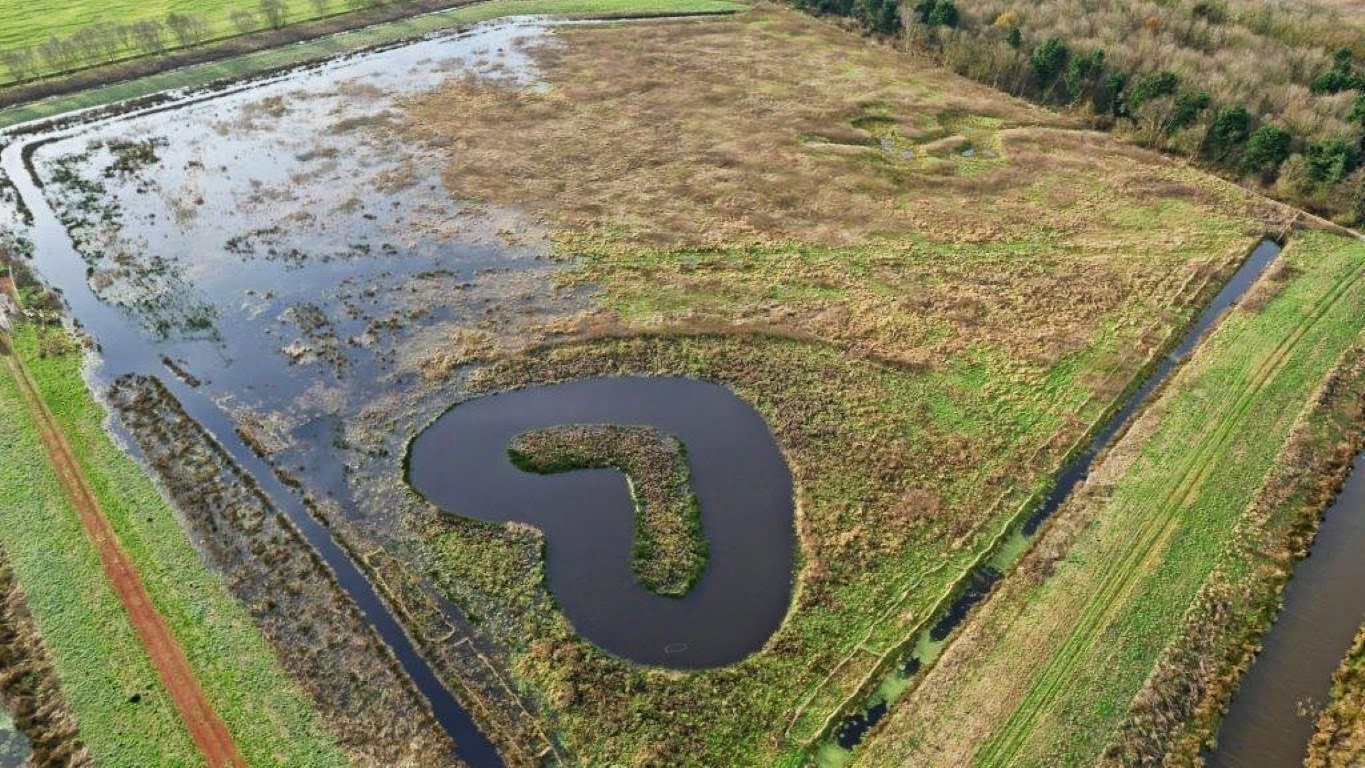
On Wednesday Elliott Corke from Hexcam came out to take the next round of aerial photos using his drone and they show the works at Methwold from a new perspective and also how wet the Hilgay site is now that we have been abstracting water into the lagoon and into the perimeter and internal ditch network. 

The eastern end of the site i
s the lowest part and is consequently very wet. The main aims over the next couple of months will be to try to get the lagoon water level up to 1.59m above sea level and to fill the internal ditches. This will enable us to graze the site more easily to keep the vegetation under control.


Looking towards Hilgay
North East Corner

South East corner

Looking North West

Looking South East


Friday, 19 December 2014

Barn owl mitigation


Nick Carter, Conservation officer (Fens)

Next year's excavation works at Methwold wetland creation site will get close to the existing barn owl box on the site and so we decided to cap the box this winter and install a new box to ensure no disturbance for any breeding owls.  

Colin Shawyer, of Wildlife Conservation Partnership, visited the site this
week to carry out the work and also to move an unused kestrel box and
re-position it in a better location.


 The site’s female barn owl was roosting in the box. After checking, when she turned out to be very healthy 385g, she was released and flew to a nearby treeline, which was where the new box was erected. 

 
The kestrel box close up

Checking her ring confirmed that she was four years old. Colin moved the old kestrel box from the nearby wood and placed it along the same treeline as the barn owl box. Hopefully both boxes will be used next year.

Friday, 15 August 2014

Wetland creation sites are just like buses


 Nick Carter, Conservation Officer (Fens)

You wait ages for one to come along and then two arrive at the same time! Construction works at the two new reed beds at Hilgay and Potter Heigham are now finished. The abstraction system at Hilgay, from the River Wissey, was finally installed, tested and shown to be leak-free. At the Potter site the water control structures to allow water from Hickling Broad onto the site was installed.

Although these important milestones have been reached the work is only really just starting. Diggers from William Morfoot Ltd are on site at Potter to create pools to act as fish refuges and feeding sites for the bitterns that will hopefully take up residence on the site. These will closely be followed by reed planters coming in to plant up the edges of these pools and to re-stock some of the caged areas that were planted last year but where the reed plugs did not grow.  

At Hilgay the site will be wetted up over the winter to encourage survival of the reeds that were planted last year and to aid their spread across the site. It will take several years however for the site to be completely filled with water and even longer for the reed beds to develop.

Bulldozer stripping the top soil at Methwold
Next door to the Hilgay site construction work has just started on the Methwold site with Fen Group’s bulldozer working to strip top soil prior to the excavation of new ditches and the construction of the perimeter bund. Work will stop at the end of the autumn to preserve the soil structure and it is hoped that all the work will be completed by next summer. This will allow reed planting to be carried out prior to the site being wetted up, with the water coming from Hilgay.