Showing posts with label Wildlife Information Service. Show all posts

Monday, 20 April 2015

Getting my vote this year…

Gemma Walker, Wildlife and Community Officer
 

I am often asked what my favourite animal is. I usually respond by saying there are too many fantastic creatures living in Norfolk to choose from, not wanting to show favouritism to any particular species.

But, recently the Urban Birder, David Lindo, really got me thinking when I took part in a survey he had launched to vote for Britain’s national bird. As I scrolled through the ten nominees I was torn as to which bird to pick. Should I choose the robin, that chirpy bird that often keeps me company whilst I am digging in the garden? How about the wren? For a little bird they have such a strong, vibrant song. Or the kingfisher, always a treat to see when I am out walking next to a river, broad or dyke. No, there could only be one bird for me, only one bird that would get my vote: the barn owl.

Barn owl, photo by Nick Appleton
Often as I travel home from work I am lucky enough to catch a glimpse of this remarkable, ghost-like bird as it quarters a field looking for a small mammal or two. A favourite past time of mine as I drive back home in the dark is to spot a barn owl on top of a road sign; it’s amazing how many barn owls seem to make use of these artificial perches. No matter how many times I see this beautiful, elegant, white and brown bird it always brings a smile to my face and I realise how lucky I am to live in a county that seems to have such a good population.

Brown hare, photo by Mark Ollett
With my vote cast for my favourite bird, I felt inspired to pick my favourite mammal. People who know me would probably guess that I would vote for the grey seal as I spend many winter hours wardening a colony, but actually they would be wrong. There has been one mammal that has captured my imagination and admiration for many years. In particular I love the folklore that surrounds this magical, mystical creature. In times gone by it was thought that witches had the power to turn in to this animal to escape their enemies, and it was regarded as an animal sacred to Aphrodite and Eros, with people giving this creature as a gift of love. But, it is probably best known for its apparent mad behaviour in March, when it can be seen leaping and bounding in arable fields across Norfolk. Brown hares would definitely get my vote.
 

Common frog, photo by Brian Beckett
If I am allowed to be greedy I would like to cast my vote for one more species, and label them along with the barn owl and brown hare as my favourite Norfolk animals. At Norfolk Wildlife Trust I often get phone calls from people concerned about this animal, it is not only my heart it has captured. You may also know of people in villages across Norfolk that volunteer their time to help hundreds of these animals cross the road to their breeding ponds. The common frog would secure my final vote. To me it is an indicator of spring, when they appear in my pond in March. It always feels like you are welcoming back an old friend and to watch the development of frogspawn to tadpole to froglet is simply amazing. A natural wonder that every child should have a chance to experience.

If you were asked what do barn owls, brown hares and common frogs have in common, what would you say? Apart from being my favourite animals in Norfolk and getting my vote they are also animals that rely on a network of wildlife corridors or wildlife stepping stones which will allow them to travel safely to breeding sites, find food and shelter.

Common frogs may breed in your pond but they probably hibernate in a totally different area, and in the summer will move away from the pond to find food and shelter. So common frogs  need a safe corridor or set of stepping stones which will allow them to travel without risk of predation or being killed by cars. We sometimes get phone calls at Norfolk Wildlife Trust from people concerned that their frogs have not returned to their garden pond, one of the reasons for this may be that one of their wildlife corridors has been blocked (by a new road or a fence) or destroyed (through the building of a housing development), and so the route to a garden they usually breed in may have been lost.

Barn owls and brown hares also depend on a set of corridors and stepping stones to travel safely from one place to another and unfortunately seeing a dead hare or owl on a road is not an unusual sight. If you are lucky enough to see a barn owl you may see it flying  backwards and forwards quartering an area looking for food. Grass verges, wide field margins and hedgerows are very important wildlife corridors for barn owls as they provide habitat for small mammals, the main food source for barn owls.

Brown hares do not have burrows like rabbits, even their young are born above ground. If a predator is nearby they stay perfectly still, not moving, until the last minute. Then when no other options remains they run extremely fast, zigzagging as they go, trying to outrun their predators. A landscape consisting of a variety of different wildlife corridors, such as field margins and hedgerows allows the brown hare room to escape and evade predators.

As well as relying on a network of wildlife corridors within the landscape these three species need our help. Barn owl numbers have fallen by more than half since 1932. This decline is due to a fall in the number of nest sites as barns and derelict farm buildings are being converted into homes, plus a decline in areas of rough grassland hunting grounds.


 One way everyone in Norfolk can help in the conservation of these three species is to share your barn owl, brown hare and common frog sightings with Norfolk Wildlife Trust. Recording wildlife is an easy way to get involved in wildlife conservation. It helps Norfolk Wildlife Trust to understand an animal’s distribution across the county, and identify any areas particularly important or lacking in these species. We also pass the records on to Norfolk Biodiversity Information Service, the Local Record Centre holding information on species,habitats and protected sites for the whole of Norfolk.

The survey forms part of a community project run by Norfolk Wildlife Trust called Delivering Living Landscapes, which is working to engage people with their landscape and its wildlife. It is supported by the Heritage Lottery Fund, Essex & Suffolk Water, John Jarrold Trust and Broads Authority.

Sightings can be submitted easily online at NWT’s website, where you will also be able to see a distribution map of all the sightings submitted so far.

You can also phone your wildlife sighting to Norfolk Wildlife Trust’s Wildlife Information Service on 01603 598 333 or pick up a recording card from one of the Norfolk Wildlife Trust’s visitor centres.

These may be my favourite species but I also hope they are special to you too. Sharing your wildlife sightings of brown hares, barn owls and common frogs will help Norfolk Wildlife Trust and Norfolk Biodiversity Information Service build up a vital picture of where these species are in Norfolk.

Tuesday, 7 April 2015

Norfolk butterflies in spring


Nick Acheson, NWT

Peacock butterfly photo by Pat Adams
Among the most heart-warming signs that winter is dying and spring is underway is the sight of a butterfly on a bright, mild day. Through the spring, summer and autumn Norfolk’s butterflies come in waves of species; and the date of emergence of adults of each species is closely related to its life cycle and, in particular, the state in which it spends the winter. The first wave of species to be seen, in early spring or even on mild days during winter, is of those which overwinter as adults, the technical term for an adult insect being imago. Some members of the Nymphalid family, the peacock, small tortoiseshell, comma and, increasingly, red admiral, and one member of the Pierid family, the brimstone, adopt this strategy.

Orange tip, photo by Ray Jones
The first to appear of the second wave of species –  those which have overwintered as pupae – is usually the orange-tip; the male a startling flash of colour over a wet meadow. He is quickly followed by three closely-related species in the Pieridae, the large, small and green-veined whites, which have also overwintered as pupae. At the same time green hairstreaks are busy around gorse, grizzled skippers in unimproved grassland, and holly blues in gardens and along hedgerows. The latest to emerge of the species which overwinter in this form is the swallowtail.

Meadow brown, photo by Maurice Funnell
While these early species are flying as adults, those which overwinter as caterpillars are pupating in spring, in readiness for their emergence as adults in summer. These include most of our familiar grassland species: browns (Nymphalidae), skippers (Hesperidae) and blues (Lycaenidae), though not all blues are blue. Surprisingly, Nymphalid species such as meadow browns, ringlets, graylings and gatekeepers may have fed on grasses as caterpillars all through winter. A few woodland species have also overwintered as caterpillars: white admirals on honeysuckle and silver-washed fritillaries (very recent re-colonists of Norfolk) on violets on the woodland floor.

Silver-studded blue, photo by David Tottman
Though it seems counterintuitive, very few species spend the winter in the most indestructible, hardest-to-find stage of a butterfly’s life cycle: the egg. Most are small, high summer butterflies which have time in the spring to hatch, feed as caterpillars to full size, and briefly pupate before emerging as adults in summer. The Norfolk species which use this strategy are the purple and white-letter hairstreaks, treetop butterflies of oak and elm respectively; the Essex skipper, discovered as recently as 1889; and the chalkhill and silver-studded blues, both of whose caterpillars are protected, to differing degrees, by ants, in return for sweet secretions.

Just one species, the speckled wood, is an exception, overwintering as either a caterpillar or a pupa. This flexibility may account for the speed with which it has spread north through Norfolk in living memory, aided perhaps by climate change.

As you see each butterfly species this spring and summer, spare a thought for the miracles of biology it has been through to reach maturity and brighten our Norfolk landscape as an adult.  

Friday, 28 November 2014

Norfolk’s wildlife in November

Nick Acheson, Norfolk Wildlife Trust
 
Stand outside on a clear night in November and let your mind reach into the doings and beings of the wild world. Overhead in the vastness and blackness of the sky are the sounds of thrushes on the move, birds retreating from the Scandinavian and Siberian cold as winter grips the boreal forests in which they bred. The night flight call of the redwings above you is a fine fizzling lisp, striping through the dark sky like a shooting star. The fieldfares with them have a choppier flight and a choppy call to go with it: a squelchy chuck-chuck like wellies sprung from wet mud. Listen carefully and you may hear the bright tick of a song thrush too, southbound in the night on wings from the forests of the north.

Tawny Owl, photo by Julian Thomas
Nearby, the local tawny owls are shouting their claim to the woods, stating their intention to breed here in late winter and to raise their round-eyed but steel-taloned chicks over the spring and summer. In the male’s gentle fluting and the female’s impetuous double-shriek the message is clear: let no other tawny encroach our patch. Perhaps, if you live close to a common or a vole-tunnelled meadow, you may also hear the breathy, insistent call of a barn owl, like a dropped can of cola being opened just a crack.

If the air is mild the woods’ edge may yet be crisscrossed by a million calls too high for human ears to hear. British bats begin their hibernation now – putting themselves on standby through the harsh, insect-scarce middle winter – but may still be on the wing and feeding in November. The cobweb of sound they cast across the night may only be heard by us with the help of a bat detector, which translates their too-high talk into sound we can hear; each species of bat with a distinctive purr, trill or rattle in the sounds the machine makes.


Bat, photo by Mark Ollett

The other mammals in Norfolk’s night may only roam where their legs will take them and are guided more than any other sense by scent. We primates, with our forward-pointing eyes, dulled noses and half-dulled ears, are designed for the day. (We even say, ‘Oh I see,’ when we mean we understand.) Most mammals though, especially those active at night, navigate the cobweb of meaning spun over woods and fields by smell. Simon Barnes expresses this magnificently in his How to Be a Bad Birdwatcher: ‘If you were to write a novel for a dog, it would have to be written not in sound symbols, like the words you are reading now, but in smell symbols.’

Hedgehog, photo by Peter Mallett
So in your November night, you may hear the garden snuffling of a not-quite-hibernating hedgehog sniffing his prickled way around the world, or his enthusiastic crunching as he crushes a slug in his teeth. Or you may imagine the trail of scent drawing a quick-eyed stoat through the dark in suit of his prey, or delighting the rubbery nose of a stripe-faced badger as he trots peaceably through a paddock hoping to find worms.

As you retreat to your warm bed beneath the eaves and beneath the covers, take with you this wild November night and the creatures which inhabit it. For over your roof the thrushes stroke the starred sky, down the lane the male owl’s muted hoots lay claim to a territory of trees, and in the twitch of a stoat’s nose is life lived and life lost.


Find out more about Norfolk’s wildlife.  Norfolk Wildlife Trust’s Wildlife Information Service is here to answer any questions or identify your species pictures.

Thursday, 24 July 2014

How well do you know your butterflies - THE ANSWERS

David Fieldhouse, Seasonal Education Officer


1: Gatekeeper

The gatekeeper is also known as the hedge brown due to its penchant for frequenting country hedgerows edged with brambles and long grasses. The gatekeeper employs an unhurried dancing flight as it hunts for ragwort, brambles and other food sources. This species can easily be mistaken for the meadow brown; the two can be distinguished due to the duller appearance of the meadow brown and the single white pupil in the eye spots of its forewing.


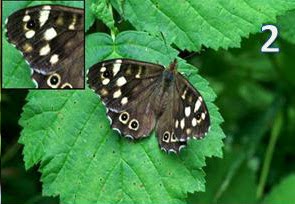
2: Speckled Wood
In the 18th Century this butterfly became known as the Enfield eye when it was identified in rural Middlesex. Today it can usually be found patrolling dappled woodland glades. The speckled wood has a greater tolerance for shade than almost any other butterfly except perhaps the white admiral. Its preferred food source is aphid honeydew located high in the woodland canopy. However, it often descends to jostle with meadow browns, ringlets and skippers amongst the bramble blossoms in sunny woodland rides. 

 
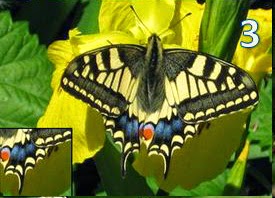
3: Swallowtail
I already waxed lyrical about this wonderful creature in my previous blog post so I’ll keep it short. Go see this superb specimen if you get the chance. The early summer will hopefully lead to a good sized second brood between mid-August and mid-September.


4: Silver studded blue
Unfortunately, this beautiful blue has become a great rarity in most parts of the UK. Countless colonies have been destroyed or shaded out. Furthermore, a reduction in rabbit populations due to myxomatosis has reduced the availability of food plants. One of the few places populations still persist is amongst the heaths of Norfolk. This is an extremely sedentary butterfly that lives in discrete colonies. The male can be distinguished from the similar common blue thanks to the thicker black margins to the wings. 

5: Brimstone
The word butterfly was probably first used to describe this butter-coloured insect. The brimstone is a widespread countryside wanderer; it can regularly be seen in urban habitats too. This species never sits with its wings open; instead it presents a wonderful leaf mimic in its underside patterning. These butterflies are powerful flyers and can often be found miles away from their food source, perhaps migrating to fresh territories.


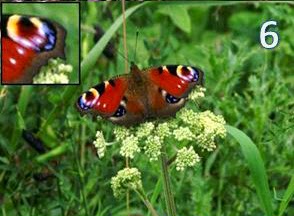
6: Peacock
The peacock is a favourite of both butterfly lovers and gardeners alike. Leave a patch of nettles to grow wild in your garden and there is a good possibility of seeing the black hairy caterpillars frequenting the leaves in June. In late summer and autumn buddleia plants can become swamped by this attractive specimen. This species has one of the largest ranges of any UK butterfly. It can be found throughout most of the UK. The peacock is one of our most easily recognized species thanks to its bright colouring and distinctive eye-spots.

7: Comma
The unique ragged outline of the comma distinguishes it from all other butterflies. This butterfly is an expert in disguise. Not only does its caterpillar look like a birds dropping but the butterfly hides so successfully during winter that few naturalists have seen its resting place. This butterfly delights in sunshine and will bask for hours with wings spread. The comma occupies a small territory, often consisting of just a few metres. It will patrol this territory, inspecting all intruders in the search for a female whilst sparring with rival males.

8: Small Copper
The small copper is the sole remaining member of the British coppers, as its relative the large copper became extinct in 1865. The small copper is relatively numerous in the UK thanks to the abundance of the caterpillars’ preferred food plants of sorrel and common dock. In good years, with lots of sunshine, three or even four broods can be produced. Despite its size the male small copper is a quarrelsome and restless little butterfly. 


Photographs courtesy of; Richard Porter, Bob Carpenter, Davis Rose, Annabelle Tipper, Paul Treloar & Elizabeth Dack.

Thursday, 17 July 2014

How well do you know your butterflies?

David Fieldhouse, Seasonal Education Officer

Butterflies are some of the most beautiful and well-loved invertebrates in the UK. Many can reminisce fondly of the sight of peacock butterflies flocking to a lilac or buddleia on a hot day, the vibrant flash of blue as a male blue flies by in search of a female to woo, or the lazy flapping of a dark green fritillary’s wings. Butterflies seem to embody the best of the British summer, as many species will only take wing on hot, windless days with full sun where they will be free to flit from flower to flower in search of nectar.

July is by far the best month of the year to see butterflies. The wonderful thing about these beguiling creatures is that you’re never far away from them. Visit your local woodland and you’ll have a good chance of seeing the ragged outline of a comma or the distinctive spots of a speckled wood. NWT Foxley Wood is a particularly good site to see the white admiral whose elegance of flight is equalled only by the purple emperor. 

If you’re closer to the coast then keep an eye out for the small heath weakly fluttering close to the ground or the large skipper. NWT Holme Dunes is a great site for these butterflies. Why not stop for a cup of tea at our newly refurbished cafĂ© and visitor centre while you’re there?

Brown argus, photo by Bob Carpenter
We are lucky enough to have a truly diverse network of habitats in Norfolk including chalky heathlands such as those found at NWT Roydon Common. More than thirty different species of butterfly have been seen at this site including the green hairstreak, which is the only UK butterfly with truly green colouration and the neat and smartly coloured brown argus.

No blog about butterflies would be complete without a mention of the jewel in the crown for butterfly enthusiasts and the public alike; the swallowtail butterfly. With a wingspan of 9cm the swallowtail is the largest UK butterfly. To see one flying powerfully over Broadland vegetation is a truly magnificent sight. They seem to be one of the few butterflies which fly with true purpose. If you go down to NWT Hickling Broad there is a high chance of seeing swallowtail caterpillars on milk parsley plants at this time of the year, their bright green colour and rubbery skin lend them an almost alien appearance. Whilst you’re at Hickling it’s also worth taking a trip on one of our boats to climb the tree tower to get a glimpse of the elusive purple hairstreak amongst the tops of the oak trees. 

How good do you think you are at identifying these delicate creatures?
Below are eight pictures, each portraying a small part of the wing of a particular species of butterfly found in the UK, how many can you identify?


Photographs courtesy of; Richard Porter, Bob Carpenter, Davis Rose, Annabelle Tipper, Paul Treloar & Elizabeth Dack.