Showing posts with label Autumn. Show all posts

Tuesday, 24 October 2017

Hedgehog season


Hedgehog, photo by Peter Mallett
This time of year you may see hedgehogs and be concerned if they need help and if so what to do. Time is of the essence – little hogs can die very quickly of hypothermia, so action is needed straight away.

Any hog under 600g will not make it through the winter – they are too small to hibernate, so will starve or freeze. Little ones, roughly the size of a tennis ball or just bigger are especially vulnerable. Here is what to do:
  1. Put the hedgehog in a high sided box or small animal carrier
  2. Give it a hot water bottle wrapped in a towel – if you don’t have a hot water bottle, then a plastic milk bottle or glass bottle filled with warm water is fine; if you don’t have an old towel, newspaper will do!  Direct heat is essential to stop hypothermia – a warm room is not enough.  Make sure there is space for it to get off the bottle if needed and keep the bottle warm – don’t let it go cold.
  3. Offer a small amount of meaty (not fishy) cat or dog food and fresh water.
  4. Keep the box somewhere warm and quiet – NOT a garage or cold shed.
  5. Ring for help or take the hog to the nearest animal sanctuary for help. Vets are often not able to offer the care that little hogs need, so an animal sanctuary is much better.
Hedgehog baby being weighed, photo by Elizabeth Dack
If the hedgehog has breathing difficulties, many ticks, fly eggs or wobbles when it walks, it is very sick indeed – tell the sanctuary this.

Ring us on 01603 598333 for local contacts or get in touch with the British Hedgehog Preservation Society.



Monday, 24 October 2016

The Ovington Ramblers: Syderstone Common and Ringstead Downs


In celebration of 90 years of the Norfolk Wildlife Trust, the Ovington Ramblers have been visiting all of the Trust's reserves in Norfolk.  Here is news of their latest visit.


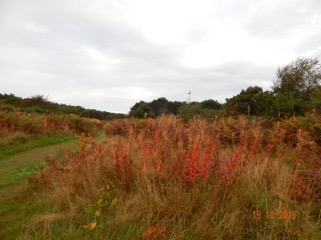
Willow herb at Syderstone Common

The weather was miserable when we set out towards Hunstanton, windy and pouring of rain. However after nearly an hour's drive and a cuppa in the car, the sun came out and gave us a beautiful autumnal day.  

We started at Syderstone Common which provided a lovely walk in glorious colour, particularly from the red leaves of a profusion of willow herb, the soft lilac colour of the heather and the straw coloured wavy hair grass. The signs of autumn were all around us with acorns and beech nuts galore and the beautiful sight and sounds of flocks of geese honking their way across the skies. We also spotted a number of light brown furry caterpillars, possibly from the tiger moth?

Our second stop was at Ringstead Downs. This was another excellent walk, quite different from the former, along a steep-sided valley where the trees grew one above another from bramble, gorse and hawthorn right up to hazel, beech, oak, ash and pine.  Mother Nature is such a clever landscape gardener! High above the treetops we watched a very large buzzard scaring away all the rooks.


Ringstead Downs

We spent quite a while looking at the amazing number of wildflowers in the chalk grassland.  There were many we didn't know but we did recognise red clover, harebell, rock rose, buttercup, dandelion, scabious, campion, wild thyme, knapweed, lady's bedstraw, gromwell, dwarf thistle and poppy.

Rock rose

Next week, weather permitting, we plan to spend the day at Hickling Broad.

Tuesday, 27 September 2016

Autumn ivy watch

David North, Head of People and Wildlife

For a few weeks in September and October, and sometimes as late as early November, ivy comes into flower. Mix sunshine, shelter, golden-yellow, pollen-rich flowers and a heady scent and you have an irresistible insect magnet. Ivy flowers in the sunshine quite literally hum with life.


In my garden what initially attracted me to look more closely at the feet deep ivy that adorns, and possible holds up, one old wall were the butterflies. Not quite clouds of butterflies but still the best show of red admirals and commas I have seen this year and with them a couple of painted ladies which seem to have been in short supply this summer.

With up to six red admirals nectaring on just a couple of metres of ivy-clad wall this made me head indoors to grab a camera and quickly return of course. Red admirals are beauties, their upper wings strikingly patterned in red, black and white but I think my favourite photo was one showing their beautiful complex camouflaged under-wings.

Ivy flowers seem irresistible to commas and red admirals but look more closely and the flowers are busy with many smaller insect visitors, which like the larger butterflies are drawn here by a rich autumn bonanza of pollen and nectar. 


Like many people interested in wildlife I can readily recognise most butterflies, some dragonflies and a few beetles. But that’s about it! With apologies to better entomologists here is my beginners’ guide to insects visiting ivy flowers.


Comma butterfly
  1. Butterflies
    let’s start with the easy group and at least in my garden it’s red admirals, commas and painted ladies that can’t resist an ivy feast.
     
  2. Honey bees
    strangely bumblebees seem largely to ignore the ivy but honeybees delight in its yellow pollen and that’s the clue to recognise them. If it’s bee-like and flying away with a load of pollen attached to its leg it’s a honeybee. The proper name for this area on the bee’s leg is pollen basket.
     
  3. Wasps
    most of us can recognise a wasp and for good reason! But they are useful pollinators too and can’t resist the ivy. Strangely though they seem to spend most of their time cruising up and down and rarely settle on a flower. Any explanations?

     
  4. Ladybirds
    perhaps our best known group of beetles! The ladybirds on my garden ivy were all harlequins and they did seem to be feeding on the pollen. Do other ladybirds do this?

     
  5. Hoverflies
    this is where it gets tricky as there are many kinds of hoverflies and some species are really good mimics of honeybees, wasps or even hornets. Unlike bee,s hoverflies have short antennae, broad waists and massive eyes. They also, like other flies, have just a single pair of wings unlike bees which have two pairs. Not a lot of help though as try counting wings when these insects are in flight. Impossible!
     
  6.  Flies
    my final group which may not be terribly good taxonomy but you know what I mean. My garden ivy attracted flies galore. Some with green metallic bodies (greenbottles?), others which most of us might call house flies and some larger ones with brown on the wings. If you are a fly expert do comment and tell me the species. But look closer and there are myriads of much, much smaller flies. This is where I just step back and wonder at the sheer diversity of insects which share our world and our gardens. 

Why not do your own ivy watch this autumn and see if my observations tally with your own. All you need is a sunny day, a few minutes of time, and a patch of old ivy decked in sunny golden globes. 

Enjoy your autumn insect watch!