Showing posts with label Flora. Show all posts

Wednesday, 28 June 2017

30 Days Wild: My journey

Norfolk Wildlife Trust's Head of People and Wildlife, David North signed up to the challenge of 30 Days Wild and got in touch with his inner wild child this June.  Close encounters with nature and priceless memories ensued.

Star gazing, moon watching, fire making, sea swimming, bee following, poppy field wandering, opening my eyes and ears for lots of looking and listening: 30 Days Wild has been an adventure.  Too many highlights to list, but I would like to share just some of my 30 Days Wild moments with you and just a few images that hopefully capture some of my special wild June moments.


Baby muntjac with 'Mum' and Swans with cygnets by David North
Waking on June 2 to look out of the window and spot a baby muntjac, still wobbly-legged and spotty-coated, and no bigger than a puppy, accompanied by its mum was a definite ‘isn’t nature amazing moment’ and the swans on Felbrigg lake later that day with nine cygnets scored high on the ‘cute factor’.

Yellow flag, bee orchids and dandelion clock by David North
I had resolved during 30 Days Wild to pay more attention to plants. After all June is peak-flower, both in my garden, and along the lanes and byways where I walk my dog, Rohan. 

Rohan enjoying the poppies
My June started yellow; with buttercups, dandelions and yellow flag iris. The middle of the month brought those stars of the plant world, orchids, into full flower, with both common spotted and bee orchids gracing my local walks. It ended in a blaze of scarlet, with a visit, accompanied by Rohan of course, to a Norfolk speciality, poppy fields in all their mind-altering crimson glory. Like stepping, Alice in wonderland like, into a different and brighter reality.I think Rohan liked it too.

Taking advice from my 30DaysWild pack I decided on several occasions during the month to try following bees. My preferred version of this was lying on my lawn in the sunshine watching countless bumblebees visiting white clover flowers and idling an hour trying to capture that perfect image. Well, no perfection, but one or two just about in focus images resulted!

I resolved with my wife to spend more time out outdoors, so gathering sticks and several outdoor cooking attempts in the garden left me, and the food, well-smoked.  I love the smell of wood-smoke but not sure how my colleagues at work took to my new smoky perfume aroma.

A curious Roe Deer by David North

During June a roe deer adopted us, spending much of its time either in the barley field we look out on, or the grass field next to our entrance. A field of waving Yorkshire Fog I’m proud to say – you see I’ve been learning my common grasses this month helped by the Norfolk Wildlife Trust’s County Wildlife Action project!  I got a lot of not very good photos of this particular roe deer, which had the early morning habit of eating the roses in our garden, but how could you not forgive such a soft-eyed, elegant, beautiful and gentle creature?  This image of her on the edge of the barley field is one of the better ones. 


Swallowtail detail by David North
 30 Days Wild, and there’s still a few days left as I’m writing this, has seen me adventure out to NWT Hickling Broad where in the hot sunny weather swallowtails were dancing over reeds and fen.But dancing fast enough to blur all my photos. This image I rather liked in an arty kind of way! I hope you do too.
Gossamer threads by David North


Hot days also brought vast numbers of tiny ‘money’ spiders to our garden, tickling hair and face as we ate our evening meals outside. This made me walk at sunrise the next morning to see if a could spot ‘gossamer’ in  the local fields – one of nature’s many miracles, when the usually hidden abundance of spiders is revealed by thin silk strands shining silver across whole fields. Spiderlings release these strands of silk to catch the wind and fly, but its only when   the sun is low in the sky at early morning, or near sunset, that these gossamer strands catch the light and are revealed.

Hoverflies enjoying the nectar on thistle head
What have I liked about 30 Days Wild? 
Well just about everything!  Like most people I need a reason to look and listen just a bit more carefully and to spend a little more time each day enjoying the extraordinary diversity and beauty of nature.  

What has impressed me most?  Probably my ignorance, for as I write this inside virtually every flower in my garden is a unique small  ecosystem teeming with life that seems extraordinary but about which I know almost nothing. Pollen beetles beyond count; small, black and perfect in every way; hoverflies in shades of marmalade- orange and black, with huge eyes that take up most of their heads. They queue in perfect hovers await their turn at my garden flowers.  Hoverflies in a holding pattern waiting for the larger bumblebees to leave some landing space. 
Barley turning gold by David North
As I write this the barley in the field next door is turning gold, and tonight, most likely, I will hear the hoots of tawny owls from a nearby wood and perhaps the barking of deer already thinking of the rutting season to come.  Yesterday my 30DaysWild action was to tempt the rabbits, which live in the brambles at the end of my garden, to come out into the open. I bribed them with a carrot. Small payment for permission to photograph them and to spend a happy half hour watching and smiling at their antics.  

One thing 30 Days Wild has taught me is that if you sit quietly and watch then wildlife may soon lose its fear of coming close.  Definitely true for these young rabbits!
Young rabbits by David North

Norfolk is extraordinary. Nature is extraordinary.  And my resolution, come the end of June, is to make ‘Wildfulness’ practice - simply spending time in, and with, nature, part of my every day and to share nature moments with friends and family. After all, whether we notice or not, we are part of nature and nature is part of us.

‘We are all, bird and human, part of the earth, of its time and its matter, impelled by the mechanisms within, the ones that order our responses to days, months, years, to light and darkness, the rhythms, circadian, circannual, that regulate what we are and what we do.' From: Esther Woolfson, Corvus. A life with birds.

Wednesday, 21 June 2017

Bee Orchids get my vote

Encounters with nature can happen in the most mundane places... 
Naturalist and Norfolk Wildlife Trust volunteer Chris Durdin happens upon bee orchids on his travels through Norwich.

"Regular readers of NWT's  blog will know that I keep an eye on a surprising colony of bee orchids in Norwich city centre. You may be glad to have an update.

They appeared again, where they first grew nine years ago, at the Big Yellow Self Storage depot on Canary Way opposite Norwich City FC. The meadow in the city is looking good, with ox-eye daisies blooming beside the path as you walk between the tyre garage and Morrison’s supermarket. 
Ox-eye daisies Norwich, Chris Durdin


All credit to the team at Big Yellow: looking after their wild flowers has become a routine they have taken to with enthusiasm.

However the bee orchids are well down in numbers this year. A count of eight is well short of last year’s record of 30. I’m fairly sure that the dry winter and spring is the reason. I’ve seen this with orchids in several parts of Europe. Because they grow from a tuber, some will have the resources to flower in any season. However a wet winter or early spring gives that vegetative growth a boost. By contrast, when it’s dry many will stay dormant. 

My part of the deal, as it were, is to encourage some publicity. I met a reporter from the Eastern Evening News and, as ever, stressed that bee orchids are special here because of their city centre location rather than being rare. 
Bee orchid by the bus route, Chris Durdin
I had a second bee orchid encounter in a surprising place on Election Day. I was knocking on doors in North Norfolk – for Norman Lamb, if you were wondering. In a Sheringham front garden a swarm of bee orchids – I estimated 130 – was a glorious surprise. 


Up the road, three painted lady butterflies and a silver-Y moth were drawn to red valerian in another garden. These are both migrants, so this year’s weather patterns have suited them, in contrast to the Big Yellow bee orchids. The lady of the house was equally enthused and very happy to talk about wildlife rather than politics!"
Painted lady on red valerian, Sheringham Chris Durdin

Chris Durdin leads monthly wildlife walks at NWT Thorpe Marshes. Details of monthly walks on http://www.honeyguide.co.uk/thorpemarshes.htm

Monday, 27 March 2017

On the verge...

Primroses and violets David North
Spring is good time to brush up on your plant identification skills as the hedge banks, lanes and roadside verges begin to blossom.  Here Norfolk Widlife Trust's Head of People and Wildlife, David North encounters some of our spring species as they emerge from winter.

Early April and nature seems pregnant with possibilities. Along the lanes close to where I live trees – oak, ash, beech and sycamore – are still winter bare, branches stark and darkly silhouetted against spring bright skies.  Birdsong and wildflowers - spring would not be spring without them, and both are in evidence as I walk my dog along familiar verges now brightened with the golds of  primrose and celandine, sky-blue speedwells and the unassuming greenish-yellow flowers of dog’s mercury. 
White dead nettle David North
 
This is the time of year I make my annual resolution to learn my wildflowers. Of course now it’s easy, the list of what’s in flower is comparatively small.  Red dead nettle is in profusion on road verges, forming magenta patches along the lanes.  Everyone knows dandelions and daisies and although both can be spotted in flower throughout the winter, their flowers are now abundant.  They do say spring hasn’t properly arrived until you can cover seven daisy flowers with a single footprint: well by my count spring is clearly here.   

More hidden are the flowers of other arable weeds, escaped from the fields onto my local road verges.  The diminutive white flowers of hairy bittercress, dull yellows of groundsel, the white stars of common chickweed and mauve-blues of ground ivy are easy enough to spot if you stop, bend and look a bit more closely among the grass.  I have some wonderful, shady sunken lanes to walk along. The banks here are festooned with literally hundreds of primroses and looking more closely amongst them I can find the black spotted leaves of early purple orchid and, already in flower, delicate white petals of barren strawberry. Woodland escapees on these shady roadside banks include the first red campion in flower, dog’s mercury, dog violet and ‘lords and ladies’ (wild arum).

'Lords and ladies' David North
The next few weeks in April will bring many more species into flower along our verges.  Look out for greater stitchwort, lacy-white cow parsley, and one of my favourites, growing on just a few local verges, the meadow saxifrage. I must dig out my wild flower guide and remind myself of how to distinguish creeping buttercup from bulbous and meadow buttercups and take on the annual challenge of speedwells: now is that one germander, field, slender, wall or ivy-leaved?

Few wildflower meadows remain in Norfolk but we probably all have a roadside verge close to where we live and these can be a haven for wildflowers.  And where there are flowers there will be butterflies and bees to spot. In the longer grass small mammals such as shrews and voles can thrive and their predators, barn owls, kestrels, foxes, weasels and stoats all hunt along grassy verges. So our roadside verges are like long, thin nature reserves and help wildlife move across the landscape

Red campion David North
Our roadside verges, if managed sensitively, can be hugely important for nature and our living landscapes. There are 238,000 hectares of road verge grassland in Britain with Norfolk alone having around 20,000 kms of road verges.  Across Britain verges support over 1,000 species of flowering plants including some species only found here.  With the loss of so many natural meadows in Norfolk today you are more likely to see a cowslip growing on a road verge than in a wild meadow. Even many orchid species, from common spotted to the early-purple and bee orchid, may be found thriving on road-sides. So why not take a walk on the verge and see what’s in flower in your local patch.  If you find something unusual don’t forget to let us know or send a photo to our gallery.    


If you, like me, would like to get to know your local wild flowers better then here are some to look out for along Norfolk’s roadside verges in April.  

  • Common daisy
  • Dandelion
    Violet David North
  • Celandine
  • Common vetch 
  • Cow Parsley

  • Garlic Mustard

  • Greater Stitchwort

  • Lords and Ladies (Cuckoo Pint)

  • Red campion

  • Red dead nettle

  • Self heal

  • Dog and Sweet Violet

  • White dead nettle


Tuesday, 7 February 2017

Exploring layers of history in the Norfolk Claylands

January may not be abundant with wildflowers but there is plenty to discover on a winter's walk as Helen Baczkowska, Conservation Officer with Norfolk Wildlife Trust records in her Claylands Diary for January.
 

Although I am an enthusiast of wild flowers, January walks are strangely a joy; for once I am not distracted by the delights of stitchwort or speedwell, by trying to sort greater from lesser bird’s foot trefoil.  Instead, I can look out on landscapes, study bare trees and cold winter ponds with a different eye.

On a walk through the heart of the Claylands Living Landscape, my brother, an archaeologist, slowed us down by lightly kicking at molehills. One revealed the treasure he sought – a thin, curved blade of flint I would not have looked twice at.  The chipped edge he showed me was human made, one of the thousand upon thousand Mesolithic flint tools discarded across these lands.  Most, he explained, were found on dry sandy soils, the reasons uncertain, yet how, he asked, had they recognised these places?  For an ecologist, this one question begs many more about how the vegetation of Britain developed as the last glaciers retreated to the north and as herds of large herbivores, from prehistoric bison, to deer and ponies, spread out across the cold steppe grasslands and scrub.
Gorse by David North


One thing I could certainly say is that even today, the patches of sandy soils left on the edge of the ice sheets can be easily distinguished amongst the ground up chalky clay of South Norfolk; earlier walking over the County Wildlife Site at Wood Green, we had crossed an area of gorse and fine grasses, visible even in winter.  In summer, heath bedstraw and heath speedwell grow here, although most of the common is clay, with meadow vetchling, meadow buttercup, cowslip and black knapweed.

Nearby Fritton Common is a Site of Special Scientific Interest, with orchids and ponds were great crested newts breed, but in the bleakness of January, my attention was drawn to the almost straight rows of oak trees, most noticeable on the western boundary.  Some of these are huge old trees, the largest in the south-west corner showing signs of pollarding – a way that small wood was once produced by cutting and re-cutting above the height of grazing stock. Collecting small wood from pollards was often the right of the commoners, whereas the timber trees themselves were the property of the lord of the manor. 


Old oak tree by Brian Beckett
In the centuries when barns and houses and especially warships were built on oak frames, these trees were valuable, their management and planting central to a farm’s income and survival; it is likely that the amount of oak across many English counties is not a virtue of ecology, so much a legacy of old economies and the insatiable need for timber for ships.  Today, being winter bare, these trees make curious shapes, with a large, gnarled trunks and many holes; invertebrates inhabit the crevices and barbestelle bats, which are have been recorded hunting over the common, no doubt find a roost in the cracks and fissured bark.

The lines of pollards continue south of Fritton Common, along a sinuous path, known locally as Snake Lane.  Hedges in the Claylands are often tall, with mature trees and a flora suggesting these are old fragments of woodland. The wide hedges of Snake Lane indicate long generations of woodland management, with pollards of oak and field maple; between them the pale slender trunks of hazel show signs of past coppicing.  Like pollarding, this produced small wood for hurdles and tool handles by cutting and re-cutting, but this time at ground level; the re-grown trees have many stems and a distinctive stump or “stool”.  A few hornbeam grow here too, their bark smooth and twisted into long creases, their timber once famed for its hardness.

Returning home, across Morningthorpe Common, a whisper makes me look up.  With a sound like the lightest of summer breezes in tall trees, a flock of fieldfares is heading to roost.  I have spotted a lot of these large, grey-backed thrushes over the past week, no doubt forced briefly south by cold weather. 
Fieldfare by Elizabeth Dack
 

By the end of our walk, dusk is wintry, grey and damp; warmth and hot tea beckon, but so do more days of walking the quiet, hidden tracks of the Claylands, exploring the endless, inseparable layering of human and natural history.

Tuesday, 17 January 2017

Your voice matters

Why now is a good time to take positive action for the future of Norfolk's wildlife by David North, Head of People and Wildlife.  
Swallowtail by Tim Melling


If you are reading this then the chances are that you, like me, care about Norfolk’s wildlife.  Fortunately huge numbers of people in our county do value nature and now is an important time to make our voices heard.

 
Norfolk Wildlife Trust is making its voice heard by writing to our MPs asking them to sign a ‘Pledge for the Environment’.  The Wildlife Trusts, along with many other conservation organisations, including RSPB, WWF, and CPRE, are all asking MPs to support measures to ensure protection for the environment and wildlife. The full text of the pledge can be read here:http://www.green-alliance.org.uk/GreenerUK
 

There are real concerns that the protection of our environment may suffer when we leave the EU and it’s not just environmentalists that are raising this concern.

You may have heard on the news that in a recent report,  The Future of the Environment after the EU Referendum (4 January 2017),cross-party MPs from  the Environmental Audit Committee (EAC) have warned  the Government of the very real risk that vital protections for our environment, countryside and wildlife could be weakened  through the process of leaving the EU. This Committee of MPs is therefore calling on Government to introduce a new Environmental Protection Act before we leave the EU.


Currently around 80% of our environmental laws are tied in with the EU so ensuring these protections for our wildlife and countryside are not weakened during Brexit is absolutely vital if we want a positive future for our wildlife. Currently more than 170 MPs nationally have signed up to the ‘Pledge for the Environment’ but only three of our Norfolk MPs are on this list.


Water vole by Kevin Anderson
If you care about wildlife then now is the time to write to your MP raising your concern that protection for wildlife must not be lost when we leave the European Union.  Let’s show our leaders that protection of the environment is not a side-issue to be thought about only after other concerns, like the economy and immigration, have been addressed but is an issue that is fundamental.


We all know and understand that a healthy environment rich in wildlife is actually essential to human well-being and the bedrock on which a sustainable economy can be built.  Let’s make sure our MPs understand this too and that they know we want Britain to set a world standard in environmental protection ensuring that our wildlife recovers from current declines.

To see a list of MPs that have signed the Pledge for the Environment and to check if your MP is on the list visit: http://www.green-alliance.org.uk/GreenerUK http://www.green-alliance.org.uk/GreenerUK http://www.green-alliance.org.uk/GreenerUK 


Please add your voice now by writing to your MP asking them to sign this pledge if they have not already done so.   For the Wildlife Trust’s top tips on how to contact your MP visit www.wildlifetrusts.org/Greener-UK/Take-Action www.wildlifetrusts.org/Greener-UK/Take-Action   Decisions made in the next two years are likely to determine the fate of our wildlife and countryside for decades to come.


Help us protect Hickling Broad – the heart of the Norfolk Broads

Please donate today:

  •  Call: 01603 625540 

Monday, 24 October 2016

The Ovington Ramblers: Syderstone Common and Ringstead Downs


In celebration of 90 years of the Norfolk Wildlife Trust, the Ovington Ramblers have been visiting all of the Trust's reserves in Norfolk.  Here is news of their latest visit.


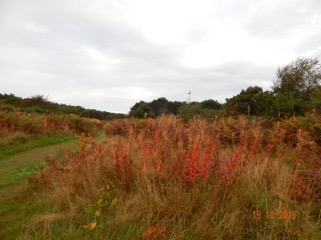
Willow herb at Syderstone Common

The weather was miserable when we set out towards Hunstanton, windy and pouring of rain. However after nearly an hour's drive and a cuppa in the car, the sun came out and gave us a beautiful autumnal day.  

We started at Syderstone Common which provided a lovely walk in glorious colour, particularly from the red leaves of a profusion of willow herb, the soft lilac colour of the heather and the straw coloured wavy hair grass. The signs of autumn were all around us with acorns and beech nuts galore and the beautiful sight and sounds of flocks of geese honking their way across the skies. We also spotted a number of light brown furry caterpillars, possibly from the tiger moth?

Our second stop was at Ringstead Downs. This was another excellent walk, quite different from the former, along a steep-sided valley where the trees grew one above another from bramble, gorse and hawthorn right up to hazel, beech, oak, ash and pine.  Mother Nature is such a clever landscape gardener! High above the treetops we watched a very large buzzard scaring away all the rooks.


Ringstead Downs

We spent quite a while looking at the amazing number of wildflowers in the chalk grassland.  There were many we didn't know but we did recognise red clover, harebell, rock rose, buttercup, dandelion, scabious, campion, wild thyme, knapweed, lady's bedstraw, gromwell, dwarf thistle and poppy.

Rock rose

Next week, weather permitting, we plan to spend the day at Hickling Broad.

Thursday, 18 February 2016

Of dead leaves, green shoots and pots of gold


David North, Head of People and Wildlife

There is no greater alchemy than the bringing of life from death. And yet, as the world turns, and February days lengthen, the sure signs of rebirth are all around us. Along every country lane, in every Norfolk copse and spinney, in field and furrow the seemingly fragile green shoots of new life are already appearing.

One of my favourite walks, very close to where I live, passes through a small wood and  despite strong wind and showers this new growth is apparent everywhere. Out of last autumn’s now grey leaves fragile shoots are pushing upwards towards air and light. Some leaves are still tightly rolled in green wands, others unfurl in exquisite translucent greens catching the ephemeral light of a February sun as it plays a losing game with darkening clouds. For moments, and moments only, each fragile leaf seems lit by its own green light as if fully absorbing the sun’s rays and then radiating them back out in a soft green fire – every new leaf a living light surrounded by crisp and very dead grey leaves and dark, brittle twigs blown out of the rooks’s nests that sway in creaking, tree-tops high above. Here in this small wood these first shoots, holding the promise of spring to come, are the first emergence of wild garlic. Wild garlic, or ramsons as its also called, that by April will carpet this woodland floor in a sea of green above which starry balls of white flowers will shine. To walk across these massed green leaves is to leave a pungent trail of wonderful, but overpowering, garlic. A smell good enough to eat, and yes, just a handful of these myriad leaves will end up back in my kitchen.


This February of course is not at all typical. The mild wet winter has brought forward the growth of many plants by several weeks. My walk to the local village shop,  even in late January, was brightened by ‘pots of gold’, the half-open cups of golden-yellow celandines, which only when the sun shone open to turn into bright yellow suns of their own. Walking the dog around our many farm lanes it’s no great surprise to find dandelion, red and white dead nettle, and mayweed in flower along our local field edges. These ‘weedy’ species are pioneers, adapted to grow fast and flower whenever opportunity arises and at least some will be in flower every month of the year.  But this year even in late January barren strawberry and dog’s mercury were in full flower, true signs of just how unusually mild this winter has been.  And now in February alongside the expected snowdrops (February fair maids as they were once known) are the first flowers of alexanders and in village gardens yellow daffodils whose trumpets really shouldn’t sound until March. The sword-like leaves of wild garlic under hedgerows are already grown large, darker green on their outer sides and lighter green on the inner surfaces of their green cowls. In other years these flowers would make their first appearance a whole month later.

My February walks are also accompanied, at least when I can hear them above the wind, by the songs of song thrush, dunnock, robin and chaffinch, the drumming of great spotted woodpeckers and the ‘teacher – teacher’ notes of great tits. All this may change of course. Should a cold spell set in then the birds now singing will need every daylight hour to feed and hopefully survive the cold of winter nights. At least for now the sounds of garden birds and growing greens along every verge spell rebirth and at least a promise of a spring to come.  

Nature’s yearly miracle of new life is upon us, but perhaps a little early!  In the next few weeks I will be keeping my eye out for blackthorn decking my local hedgerows white, first nodding violets flowering in my garden and the pure gold, shining in wet  hollows, of one of my favourite flowers, marsh marigolds or kingcups as they are also known. Out of dead leaves everywhere the miracle of new life - the kingcup is dead, long live the kingcup.

Saturday, 26 July 2014

Flora on NWT Weeting Heath


Matt Twydell, Weeting Heath Summer Warden
 

Spiked speedwell
NWT Weeting Heath is a prime example of a Breck Grass Heathland. Because of this we get a number of specialist Breckland plants that grow here. The main and rarest one is the Spiked Speedwell Veronica spicata (Eastern sup species). This plant flowers on the heath during July, some of the denser patches are fenced off at Weeting to protect the plants from grazing.
 

Spanish catchfly

A lot of the plants that grow at Weeting require ground disturbance for the successful establishment of new seedlings, this can be accomplished through turf stripping, rotivating or naturally through livestock or rabbits. One plant that benefits from disturbed ground is Spanish Catchfly Silene otites, these inconsequential flowers make this a hard to spot species in the long grass. 


One of the more vibrant flowers that grows here is the Maiden Pink Dianthus deltoides, which seems to have been spreading in recent years.


Maiden pink

Broad Leaved Hellborines, one of the few Orchids recorded at Weeting Heath are now in flower outside the Visitor Centre in small numbers.

Most of these plants grow in areas which are restricted to the public due to nesting stone curlews or woodlarks. You are only able to venture onto the heath when being accompanied by either the warden or a volunteer, but please do enquire at the visitor centre.


Stone Curlews
Over the last month we have had an increase in stone curlews at Weeting Heath, with a peak count of 17! Most of them are part of a post breeding flock which includes juvenile and adults. But we do have a couple of new pairs that have arrived. One of these went down on a nest a couple of weeks ago, so fingers crossed we shall have some more chicks by the end of the first week of August.

We also rang another chick several weeks ago, which has this type of flag on its leg, so keep an eye out for it.
Stone curlew chick


The upper right black (its ring combination) pair, who have fledged 1 chick already, hatched another 2 chicks last week as well. We will be hoping to go out and ring these as well in a few weeks.


Skipper on scabious plant
Other Wildlife News
Last week I found a juvenile redstart in the pines on the heath, which probably means that they bred on site or the surrounding woods, which is a first for a number of years here at Weeting.


Turtle doves, now a rare site in the countryside, continue to be seen on the woodland trail here at Weeting, with a total of three singing males being seen, young haven’t been seen so far but hopefully they have successfully fledged young this year.

Butterflies continue to be seen in good numbers. On my last butterfly transect I counted over 300 individual butterflies comprising 15 different species; the first painted lady of the year was also seen on the site last week.