Showing posts with label Moths. Show all posts

Thursday, 7 July 2016

Weeting Warden's Diary: June

By Sophie Harrison and Abi Nell

The end of May was wet and cold, but despite this a new pair of stone curlews arrived and started sitting on eggs at NWT Weeting Heath. After sifting through our records we discovered that the male bird with ring combination (BTO, ORG, RED, RED) was originally ringed back in 2012 not far from Weeting. He had been previously recorded at Weeting in both 2013 and 2014 with a first nesting attempt recorded on neighbouring land in 2015. His partner with ring combination (LBU, -, LGN, DG/BTO) was first ringed in 2012 on Hockwold heath and had her first breeding attempt with another male in 2014. Stone curlews mate for life and only change partners if one passes away. This male is therefore her second partner and more her own age.
 

A heat wave at the beginning of June gave this pair a fighting chance and they were spotted taking turns to incubate the eggs a few days later. We were able to capture this pair on camera on 6 June and hopes were raised that this pair could rescue this year's breeding population at Weeting. However, a few days before hatching these hoped were dashed! Late one night, a hungry passing opportunist in the form of a vixen took quiet a fancy to these eggs… and had herself a tasty midnight snack! She was first seen at 23:19pm when she carried off the first egg. The crafty vixen then returned to gobble the second egg a minute later. The birds were then seen at 23:25pm when they returned to their empty nest. Dismayed, they abandoned the scrape. Their dismay was also shared by the team here at Weeting!

Since this happening on 12 June, this pair has been feeling sorry for themselves and have been seen moping about the heath looking a bit lost! We have been watching this pair very closely to see if they will have one last breeding attempt before the end of the season. However, as June begins to draw to a close, this look less likely as the stonies will require three weeks for egg incubation and six weeks for the chicks to fledge.  Earlier this week the pair were seen displaying and giving each other food parcels. Maybe this is in consolidation over their loss or it may be a positive sign signalling another breeding attempt! Fingers crossed that July's blog will have some hopeful news!

On Saturday 4 June, Weeting Heath held the event ‘Fantastic Night Fall Flyers’. The aim of the evening was to see if we could find bats, moths and nightjars unique to Weeting Heath. The event was a huge success with a great turnout! Many thanks to Matthew Blissett for his fantastic tepee moth trap set up! This trap along with four others running that night produced some fantastic moths!  Highlights included the Breckland specialist Lunar Yellow Underwing, and also fox moth, clouded buff, and elephant hawk moth (heathland specialists).

However it was the Cream Spot Tiger with its striking distinct colouration that stole the show! Cream Spot Tigers  feed on dandelion, dock and plantain. When threatened, they flash their bright red abdomen and yellow and orange underwing to avoid being eaten! (Rumour on the bird grape vine also informs me that they don’t taste very nice either!!) It may be one of the UK’s most beautiful and distinguishable moths with its striking pale spots, but this defence is necessary when they have one of the UK’s smallest population distributions!
We were out in force with bat detectors that evening,  and  picked up Soprano and common pipistrelle. Even the stone curlews were playing ball that night, as right on cue a pair soared over the pine belt during the late night walk in full view calling loudly to each other! The evening was rounded up with hot chocolates (complete with marsh mellows and cream of course!) and home baked cookies from Weeting’s star baker- Abi Nell.

The weather hasn’t made its mind up this month so has greatly confused many of our breeding species here at Weeting. Consequently, spotted flycatchers have not yet been able to breed successfully in the pines and butterfly counts have been low and in-frequent. However, when the sun decided to shine we had Holly Blues emerge and the first generation of Meadow Browns for the season! The only species that has been unaffected by this weather is the treecreepers! Terry and Teresa that decided to nest behind the VC sign last year decided they wanted a change of scenery. They relocated behind a drainpipe on the side of the west hide. This move was clearly a well thought out idea as they successfully fledged all four chicks!

This month was also the relaunch of the Breckland Local Group. The first meeting was a huge success with guest speakers Matthew Blissett and Sam Neal talking about the fantastic wildlife and reserves in the Brecks, and how important it is to get involved with monitoring and conservation work. The next event is a guided walk at Weeting Heath at 10am on Sunday 10 July. Come and discover the great variety of flora and fauna that Weeting Heath has to offer! Entry is £2 for members and £3.75 for non-members. Pop into Weeting Heath Visitor Centre for more information or contact the Breckland Local Group on 01953 548304 for more information.

An easy way to get involved with wildlife monitoring or recording in the Brecks  is to find out what NBIS (Norfolk and Norwich Naturalist Society) has to offer. Sophie and Abi have been taking advantage of the fantastic free courses from NBIS as part of their Little Ouse Wildlife Recording Festival this month. One Tuesday night they attended a freshwater invertebrates identification session with Dan Hoare (Norfolk and Norwich Naturalist Society) and the NBIS team at St Helens picnic site. The sections of the Little Ouse we sampled were full of life, with many keystone species and species that indicate river health. We discovered larvae a plently including this rather smiley beetle larvae and were amazed by the number of tiny stickle-backs, minnows and bullheads that found their way into the net! Follow the link to find out more about the NBIS events programme.


Now live: watch Sophie show YouTuber, Maddie Moate our stone curlews in NWT's 9 for 90 film in celebration of our 90th anniversary.


Wednesday, 24 February 2016

The smallest moth with the biggest name!

Eilish Rothney,  Trinity Broads Warden


The lovely little moth I have in mind is Colephora hydrolapathella – a bit of a mouthful, it does have an English name: “The Water Dock Case-bearer” not much shorter! 

With a wingspan of only 13-14mm this tiny moth is classed as a “micro-moth” and there are more than 1,400 species of these in the UK. What is so special about this one I hear you asking? Well it is one of the rare micro-moths, designated a UK Biodiversity Action Plan species and difficult to identify in the adult form. The only guaranteed way to identify it correctly is to dissect the poor little blighter. But the good news is – the larval form over-winters in a small case, only found on Water Dock (hence the name, I always like it when it does what it says on the tin!).


So first we need to know where the water dock grows and this is often in very wet inaccessible areas so the species is probably under-recorded. But if you like having a damp walk in the fresh winter air -look out on dyke edges for the brown winter leaves and tall stems of this dock. Check these tall stems all along their length and spot the 10mm long cases. If you are lucky enough to spot one please place the stem back where you found it and send us in your records! If you are not on a NWT reserve then please send you records to:  tdavis@butterfly-conservation.org 

Another reason this little moth is special is, it is what we call an indicator; it tells us by its presence, or absence, how healthy and how diverse the habitat is. This in turn tells us whether we are managing the habitat correctly. Farmers – if you find this on your land it will also inform the agri-environment scheme that you have good wetland habitat and dykes. Although not rare, the Water Dock itself is mainly found in central and south east England, sometimes called “Greater Water Dock” with flower stems up to 2m tall and large leaves.

I remember from my childhood the phrase “look after the pennies and the pounds look after themselves!” Well I think it can be true in nature, if we look after the little vulnerable things then the bigger things will benefit as well and we will have a rich and diverse habitat.

Tuesday, 13 October 2015

Bat and moth evening with Norfolk Wildlife Services

Barry Madden, NWT volunteer

Smokey lines of straggly cloud silhouetted against an horizon of red and orange pastel hues; ragged streams of gulls silently and purposefully moving westwards towards their roost on the mud wastes of the Wash; shadow forms of rabbits hopping across the open grassland in the quickening dusk; and the fetid smell of rotting flesh emanating from stinkhorn fungi attracting flies to carry its spores to pastures new. 

Just a few impressions from an evening spent with NWT colleagues at the Mars Foods factory in King's Lynn helping to run a bat and moth evening for staff. First off we were given a tour of the site, extending over several acres, by Dave a most enthusiastic champion of all things wild and natural. He is working hard to develop the whole area into a wildlife haven and our job was to help spread some of this joy to other employees of the company.

But first some context. Mars Foods occupies a site on the Hardwick Industrial Estate in Kings Lynn, an industrial complex like many others scattered around our county and on first impressions the very antithesis of a wildlife friendly landscape. But let's look a bit closer. Behind the facade of iron fencing, beyond the tarmac car parks full of our expensive tin cans and rows of utilitarian warehouses lies another hidden world. A world that cannot be seen from the road; a world that by its very nature and because of its very location can remain largely undisturbed and peaceful. And it is here that enlightened staff, with advice and guidance from Norfolk Wildlife Services (NWS), are giving nature a helping hand, shaping what already exists into something better; creating something new from neglected tracts of otherwise sterile space. 

 
The space in question comprises small areas of mixed woodland and bramble scrub, tall boundary hedging and a large tract of open grassland some of which is being left un-mown to encourage wild flowers to flourish. The northern edge of the site is bordered by a small river, itself edged with mature trees, offering another dimension for wildlife to thrive. Log piles have been deposited in sheltered nooks, a pond has been dug, nest boxes positioned and a walkway created so that staff have somewhere to stroll during their breaks. It really is very simple, but so very effective.

Our primary concern this evening was to guide a small party of staff members on a bat hunt around the more wooded parts of the site. To this end we furnished each participant with a bat detector device that picks up the echo location calls of bats and converts them to electrical output that we humans can hear. Each species of bat emits signals at a particular frequency and by setting the dial on the bat detector to frequencies favoured by the common, more likely, inhabitants of the area their chatter can easily be picked up. It wasn't long before we were picking up the chipping calls of pipistrelles hunting around the top of a high hedge. At least three of these tiny winged mammals were present hunting mosquitoes and other flying insects of the night. On more than one occasion we were able to listen to the so called ‘terminal  buzz’, a series of increasingly rapid signals made as the bat zeros in on its prey. These emissions, very much akin to someone blowing a raspberry, are proof that ample food is present here and the bats were feeding well.
 

On one occasion we also picked up the slower more rhythmic call of a noctule bat, a much larger species sadly in steep decline over much of the country nowadays. Its presence here is therefore all the more welcome.

On then to the moth trap which tonight seemed to provide an irresistible lure for numerous crane flies that festooned the dew laden grass. Moths were few at this season and unfortunately we didn't have time to wait for the main emergence. However both large and lesser yellow underwings appeared as well as a few square spot rustics and a snout. A small taste late in the year of what the site could produce. Further trapping events are planned and will certainly produce many more species.

A most enjoyable and informative evening. The management and staff of Mars Foods must be congratulated for their excellent efforts in sympathetically managing this site for the benefit of people and wildlife. It doesn't take much you know; just an appreciation of the positive impact working with nature can bring to the workplace, a realisation that we are part of the natural world and not aliens within. Most importantly the boundless energy of committed individuals such as Dave to make it happen. NWT and NWS are proud to be part of this activity.

NWS can help your company too. For further details visit their page on this website.


Read Barry's own blog at http://easternbushchat.blogspot.co.uk 

Thursday, 8 August 2013

Cley Catch-up: 8 August 2013

Barry Madden, Volunteer Bird Guide at NWT Cley Marshes

Avocet chick, photo by Barry Madden
It’s been a successful breeding season for the birds of Cley. During June and July the scrapes were alive with avocet chicks. Everywhere you looked there were freshly hatched broods busily foraging around the shallow margins picking small insects from the water’s surface. Scaled down versions of the adults, complete with small upturned bill, it is amazing how these tiny creatures begin feeding themselves almost as soon as they hatch. They seem quite fearless as they enthusiastically explore their surroundings in their quest for sustenance. The ever vigilant parents stand sentinel close by, ensuring their particular balls of down come to no harm. 

Coots, photo by Barry Madden
Their most frequent targets, posing real or often only imaginary threats, were marauding gulls, marsh harrier, wood pigeon, shelduck and coot; not one was able to get anywhere near the chicks without a spirited and sustained attack. It is testimony to the high quality of management activity across the site that so many of these iconic birds successfully hatched young. The unceasing efforts of the warden and reserves staff have borne fruit; their dedication deserves high praise. In fact I heard some members of the public say just that as they delighted in the antics of a pair of chicks feeding close to Bishop’s Hide. It is very heartening to know the expertise of NWT staff is appreciated by members of the public whose support is so vital to the Trust’s work.
 

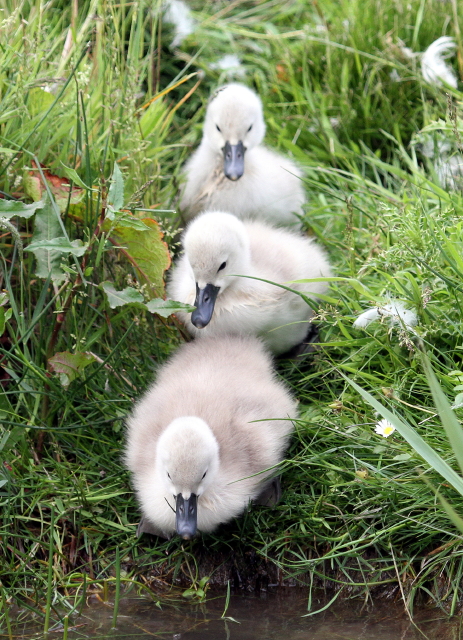
Cygnets, photo by Barry Madden
There has been much evidence of other breeding success. A walk around the reserve has often revealed young lapwing and redshank chicks tottering across the wet meadows where grey-lag goslings had formed a crèche off East Bank. Meadow pipits, reed buntings, sedge warblers, reed warblers, and swallows all seem to have fared well, whilst the marsh harriers raised three healthy offspring which have been much enjoyed by the visiting public. 


But Cley is not all about birds. Largely thanks to the glorious warm weather of the last month it has been insects that have taken centre stage. 

The wealth of wild flowers covering the nature reserve provides breeding and feeding opportunities for a multitude of butterflies, moths, bees and other 6-legged creatures. At times the south facing beach slope has been awash with colourful 6-spot burnet moths, common blues and gatekeepers. The cessation of winter bulldozing of the shingle has allowed a very interesting plant community to develop all along this area, especially close to the beach car park. Here at times the myriad thistles, trefoils and grasses have been covered with dancing butterflies. 

Silver Y Moth, photo by Barry Madden
Today a sprinkling of migrant silver Y moths were busy flitting from flower to flower; their ability to hover hummingbird-like enabling them to drink deeply from various tubular flowers that others were unable to exploit. Successful breeding of several species is evidenced by small armies of caterpillars busy munching away on their chosen food plant. The larvae of peacock and cinnabar moth are on display for anyone wishing to look closely at ragwort and nettles, and I was lucky to see a painted lady caterpillar wriggle across the path in front of me. 

So much life, and it’s not there by accident. Sympathetic management based on decades of experience allows the reserve to flourish all year round. Much of this activity takes place away from the public gaze, or in the early hours and is therefore not always obvious. It is all geared to providing wildlife the best possible habitat and people the best opportunity of observing what decides to call Cley Marshes home.

Friday, 26 July 2013

The Weeting Warden’s Diary: July

Simon Thompson: Summer Warden Weeting Heath NNR

Inside the Weeting Heath moth trap, photo by Simon Thompson
I’ve been getting quite excited about moths this month. I’d been to a trapping session or two before but had never run a trap of my own. 10 traps in and I’m well and truly hooked. Being a beginner is great, with in excess of 800 species of macro-moth, generally speaking the big ones, and an additional 1,600 or so micro-moths there’s almost always something new in the trap. The learning curve is steep but it’s amazing how quickly you begin to pick things up and become familiar with the different families of moths and the more regular species.

 
Tawny Wave, Scopula rubiginata, photo by 
2011 Weeting Summer Warden, Amy Green
The list is building steadily each week and we’re now up to 150 macro-moth species for the year. The full Weeting Heath species list has been compiled by various trappers over the last few years including previous Summer Wardens, Amy Green and Ellie Rickman and it is now at 290 macro- and 80 micro-moth species. 

The list includes a few rarities; Tawny Wave - a Red Data Book species trapped both this year and in 2011; False Mocha – a Biodiversity Action Plan priority species recorded in 2010; and Lunar Yellow Underwing – a nationally scarce species which is in decline, recorded regularly this year and also in 2008 and 2011. 


Small Elephant Hawkmoth, Deilephila 
porcellus, photo by Simon Thompson
It is obviously a real buzz to be recording rarities however some of the more common moths are some of the most popular with visitors here at Weeting, particularly the large, flamboyant hawkmoths. We have Privet-, Pine- Eyed-, Poplar-, Elephant- and Small Elephant- hawkmoths visiting the trap regularly. One trap produced 34 of the bright fuchsia and mustard coloured Small Elephant Hawkmoths which really was a sight to see!


Rosy Footman, Miltochrista miniata,  
photo by Simon Thompson
If you and your family are interested in seeing how a trap works then we are holding an event in August called Fantastic Nightfall Fliers. We’ll be having a look at the moth trap and some of the moths that it catches, heading out for a short walk in the forest, hopefully hearing stone curlews call and finding some creatures that hunt moths in the night, before heading back to the visitor centre for a hot chocolate. The event will be held here at Weeting Heath on Saturday 24 August from 8 – 10pm. Tickets cost £2 per person or £6 for a family ticket (2 adults and 2 children). If you just can’t wait that long then feel free to contact me at the NWT Weeting Heath Visitor Centre (Tel. 01842 827615) and I’ll be happy to let you know when I’m planning the next trapping session.

Eyed Hawkmoth, Smerinthus ocellata, photo by Simon Thompson

Lobster Moth, Stauropus fagi, photo by Simon Thompson
For more great moth pictures from the Weeting Moth Trap, have a look in our Facebook album.